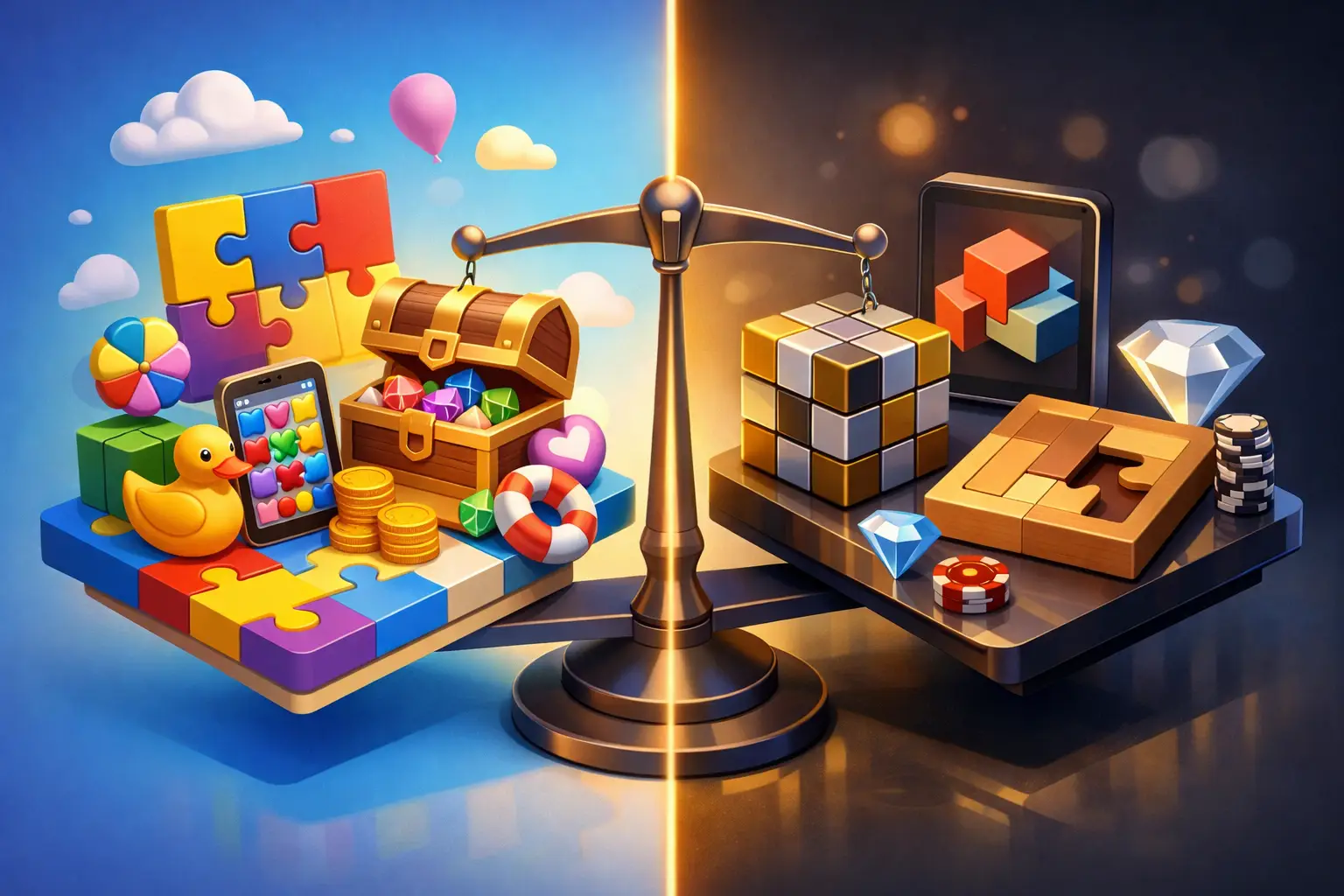
A puzzle game earns its place on your phone when it gives you a satisfying little pause in the day. The free puzzle games vs premium question is not really about which option is better for everyone. It is about what kind of play feels good in your routine: a complete experience you buy once, or a growing game you can return to for a few thoughtful moves whenever you have time.
For many players, the best choice is the one that feels generous with attention. You want levels that make you think, rewards that reflect real progress, and a game that stays welcoming whether you play for seven minutes before bed or settle in for a longer Sunday session.
Free Puzzle Games vs Premium: The Real Difference
Premium puzzle games usually ask for payment before you begin. In return, you generally get a defined game experience with its full core content ready to play. That can be a wonderful fit if you prefer a clear finish line, want to avoid making decisions about optional extras, or enjoy working through a carefully contained collection of puzzles.
Free puzzle games remove that first decision. You can try the mechanics, see whether the art and pace suit you, and build a play habit before spending anything. A well-made free-to-play game should make the free experience feel complete, not like a preview that stops just as the garden begins to bloom.
The trade-off is that free games often grow over time. New levels, themed worlds, events, collections, and community activities can give regular players more reasons to return. Premium games can feel more self-contained, while a live game can feel more like an ongoing hobby. Neither approach is automatically more respectful. The details matter.
What You Are Paying For, If You Pay at All
With a premium game, your payment is straightforward: you purchase entry to the experience. That simplicity has real value. There is no need to consider whether a booster, reward track, or cosmetic item fits your play style. You can simply solve puzzles and move forward.
In a free-to-play game, purchases should enhance your experience rather than decide whether you are allowed to continue. Optional boosters can help when a tricky board has had you rearranging the same corner for a few attempts. A premium reward track can add extra decorative items and progression rewards for players who enjoy collecting them. These choices work best when they feel like conveniences and treats, not pressure.
A useful question is: if I never buy anything, will this still be a game I am happy to play? If the answer is yes, optional purchases become what they should be - a personal choice. Some players will enjoy saving a few boosters for a difficult level. Others will take pride in clearing it with careful planning and no extras. Both are valid ways to play.
Value Looks Different in a Daily Puzzle Habit
It is easy to compare games only by their starting cost, but the better comparison is value over the time you actually play. A premium title may be excellent value if you want a focused set of puzzles to complete over a few weeks. Once you reach the end, you may be ready to choose another game.
A free game can offer value through variety and continuity. One day you might clear a dozen match-3 levels on your commute. The next, you might use your earned rewards to place new flowers, finish a collection, or join a relaxed co-op goal with other players. Those small layers can make a familiar puzzle mechanic feel fresh without making it complicated.
This is especially appealing for adults who use mobile games as a wind-down ritual. You do not need a two-hour block of time to see progress. Clearing 47 levels over a week, adding 12 new blooms to your garden, or completing a daily challenge can make short sessions feel pleasantly productive.
Still, more content is not always more value. If a game piles on too many currencies, menus, and reminders, the quiet pleasure of solving a board can get lost. The strongest free games keep the path clear: make a few good swaps, earn useful rewards, and choose the extra activities that interest you.
Level Design Matters More Than the Price Tag
A puzzle game can be free, premium, or anything in between, but satisfying level design is what brings you back. Great match-3 boards have a rhythm. You notice an opportunity, set up a special piece, clear a blocker, and watch a plan come together. Every swap feels amazing because it has a purpose.
Look for games that introduce new board elements gradually and give you room to learn their behavior. A difficult level should invite another attempt with a different strategy, not leave you wondering what you were supposed to do. Smart use of boosters should feel strategic too: a helpful tool when you choose it, rather than the only answer.
Hand-crafted levels are particularly valuable for players who enjoy noticing patterns and improving over time. They create those memorable moments when a move you almost missed clears the whole side of the board. Price does not guarantee that feeling. Care does.
The Social and Creative Side of Free Play
Premium puzzle games often center the puzzles themselves. Free games can add a wider sense of place around them, especially when they include decorating, seasonal themes, and cooperative play. For some people, that added context is the reason the game becomes a lasting favorite.
Garden-building offers a gentle form of creative progress. You are not only clearing tiles. You are choosing where a path goes, adding color to a quiet corner, and watching your space take shape one reward at a time. It is a calm companion to the more focused satisfaction of a difficult level.
Social features are worth considering, too. A friendly team goal or leaderboard can make progress feel shared without turning every session into a contest. The right amount of connection is often light: a reason to contribute, celebrate a strong week, and enjoy being part of a community that likes the same kind of puzzle-solving you do.
How to Choose the Right Puzzle Game for You
Start with the kind of relationship you want with a game. If you love finishing a complete collection and moving on, premium may suit you beautifully. If you want a familiar game that keeps adding new worlds, decorations, and challenges over months, free-to-play may be a better match.
Then consider your budget preference. Some players like paying once and never thinking about purchases again. Others prefer trying a game at no cost and only supporting it if it becomes part of their routine. Neither choice says anything about how seriously you take puzzles. It simply reflects how you like to spend your leisure time.
Finally, pay attention to how the game makes you feel after a session. Did you solve something clever? Did your garden gain a new detail you like? Did you have a clear choice about what to do next? A game that respects your time leaves you with a small sense of completion, even when you only had a few minutes to play.
Garden Match Puzzles is built around that balance: easy-to-understand match-3 play, plenty of hand-crafted levels, and a garden that grows alongside your progress. You can play anytime, and optional purchases are there to support your preferred pace rather than gate the path ahead.
The best puzzle game is not the one with the most dramatic promise. It is the one you are genuinely happy to open tomorrow, knowing there is another satisfying board, another thoughtful choice, and perhaps one more bloom waiting in your garden.