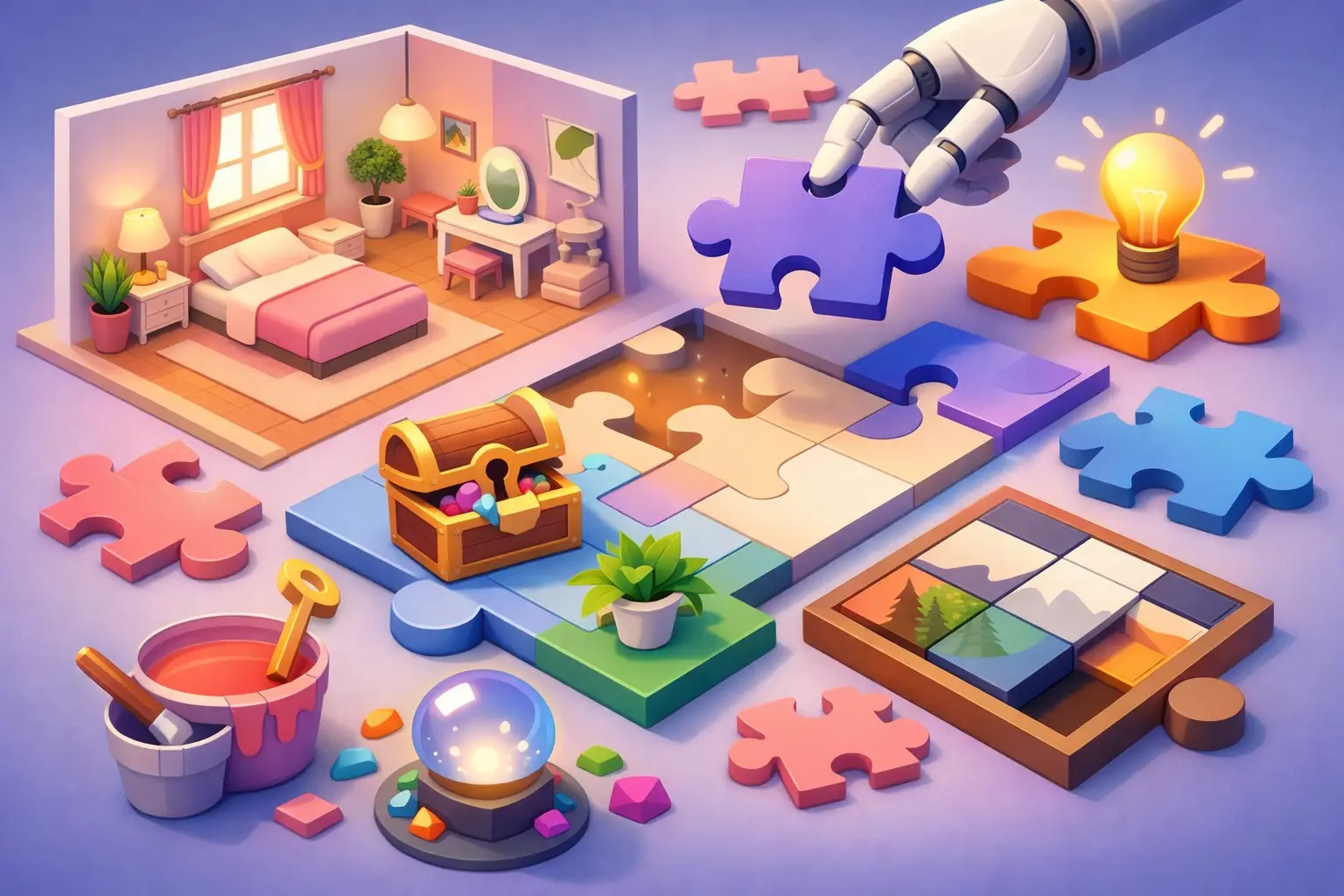
Some mobile games ask you to choose between relaxing and feeling engaged. Decorating games with puzzles work because they give you both at once. You get the steady pleasure of making something look the way you want, and you get the clean satisfaction of solving a problem before moving on to the next bloom, bench, path, or corner of a world that is starting to feel like yours.
That mix matters more than it may seem. For a lot of players, especially those fitting games into small pockets of the day, pure decorating can feel passive after a while, while pure puzzle play can start to feel abstract. Put them together well, and every match has context. Clear a level, and the reward is not just coins or points on a screen. It becomes a new flower bed, a brighter fountain, a fresh patch of color, or one more visible sign that your time added up to something.
What decorating games with puzzles do better than either genre alone
The strongest appeal is momentum. Puzzle levels provide structure. Decoration provides meaning. One keeps your hands busy, and the other keeps your attention rooted in a place you want to return to.
This is why the format feels so comfortable in 5 to 20 minute sessions. You can complete a level or two, make one design choice, collect a reward, and leave with a sense of closure. That rhythm is well suited to a commute, a coffee break, or the quiet stretch before bed. You are not staring at an endless score chase. You are tending to progress you can actually see.
There is also a useful emotional balance here. Puzzles create a little friction - just enough to make success feel earned. Decorating softens that friction by giving the reward a cozy destination. Instead of stress building on stress, effort turns into atmosphere. A solved board becomes a new terrace, a trimmed hedge, a lantern path, or a room with more personality than it had ten minutes earlier.
Not every game in the category gets this balance right. If the puzzles feel detached from the decorating, the whole thing can start to feel transactional. If the decorating choices are thin or repetitive, puzzle wins lose their sparkle. The best experiences make each side support the other.
The real appeal is visible progress
Many adults do not want their downtime to feel empty. They want it to feel light, but still worthwhile. That is where decorating games with puzzles have a quiet advantage.
Visible progress is reassuring. You clear 12 levels across a week, and now your garden has new blooms, a more polished walkway, and a corner that finally looks finished. That kind of progress lands differently from a number climbing in a leaderboard. It feels personal. It reflects taste as much as persistence.
This is also why decorative progression works so well alongside collections, events, and themed worlds. A good puzzle game gives you short-term goals and long-term shape at the same time. One session might earn you a small upgrade. Over a month, those small upgrades turn into a world that looks cultivated rather than random.
That sense of cultivation matters. People come back to these games because they like seeing a place grow through seasons, choices, and steady attention. It is less about showing off and more about enjoying a space that becomes more finished with every session.
Why puzzle mechanics make decorating feel earned
A decoration by itself can be pleasant. A decoration you earned through good play feels better.
Puzzle systems add texture to rewards because they ask something from the player first. You are reading the board, planning around blockers, deciding whether to save a booster, and spotting the move that opens up the whole level. Even when the mechanics are easy to understand, there is still enough decision-making to make success satisfying.
That is a big reason match-3 remains such a natural fit. The rules are simple, but the levels can still create variety through layout, objectives, and obstacle design. You are not memorizing a complicated control scheme. You are making quick, readable choices. When every swap feels good, the path to your next decorative reward feels good too.
There is a trade-off, though. If puzzle difficulty spikes too sharply, the decorating loop can lose its calm rhythm. If levels are too easy for too long, rewards can start to feel automatic. The sweet spot is challenge with flow - enough resistance to keep your attention, enough consistency that your progress keeps blooming.
Decorating adds identity to a puzzle game
Puzzle games are satisfying, but decorating gives them personality. It answers a simple question: what are you building toward?
Without that layer, even strong puzzle design can begin to blur. One board follows another. Objectives change, blockers rotate in and out, and the experience remains polished but abstract. Add decoration, and suddenly there is a place, a theme, and a sense of authorship. Your choices may be light compared with a full design simulator, but they still create ownership.
That ownership is especially powerful in cozy settings. Gardens, parks, courtyards, and seasonal landscapes all give decorative progression room to breathe. They are naturally suited to gradual change. A garden does not need to transform all at once to feel rewarding. One path, one bloom, one fountain detail at a time is enough.
For players who want their games to feel restorative, this matters. The act of returning to a pleasant space and improving it little by little is part of the reward. It is not only about beating the next level. It is about tending to something.
What players should look for in decorating games with puzzles
If you enjoy this genre, it helps to know what separates a lasting game from one that feels good for a weekend and then fades.
First, look for puzzle design that keeps introducing fresh ideas without becoming fussy. New mechanics should add interest, not clutter. A well-made game can offer depth without making every level feel like homework.
Second, the decoration loop should be more than a thin layer of wallpaper on top of puzzle progression. The visual changes need to feel meaningful. Even small upgrades should be easy to notice. If you have to squint to see what changed, the reward loses force.
Third, variety matters. Themed worlds, seasonal touches, side activities, and collections all help the experience feel alive over time. That said, more is not always better. If too many systems crowd the screen, the core charm gets buried. The best games stay generous without becoming noisy.
Finally, fair progression makes a real difference. Players are smart. They can tell when a game respects their time and when every system is pushing too hard. A quieter, more confident approach often keeps people around longer because it leaves room for routine, comfort, and self-directed play.
That is part of why Garden Match Puzzles has found its place with players who want depth without complexity. The match-3 foundation is easy to pick up, but the broader loop of building, collecting, and moving through themed worlds gives each session shape.
Why this genre has staying power
Decorating games with puzzles have lasted because they fit real life. They are easy to start, satisfying in short sessions, and generous with visible results. They let players exercise taste without needing a huge time commitment, and they make puzzle-solving feel warmer and more grounded.
They also age well as hobbies. Some games burn hot and fade fast because the fun depends on intensity. This genre works differently. Its pleasures are cumulative. A few levels here, a few design choices there, and over time you have a record of your attention. Your garden looks fuller. Your worlds feel lived in. Your progress has shape.
For many players, that is exactly the point. They are not looking for noise. They want a game that fits into the day gently, rewards clear thinking, and leaves behind something a little brighter each time they play.
If that sounds like your kind of pace, decorating and puzzles make a very good pair - one gives you the challenge, and the other gives that challenge somewhere lovely to land.