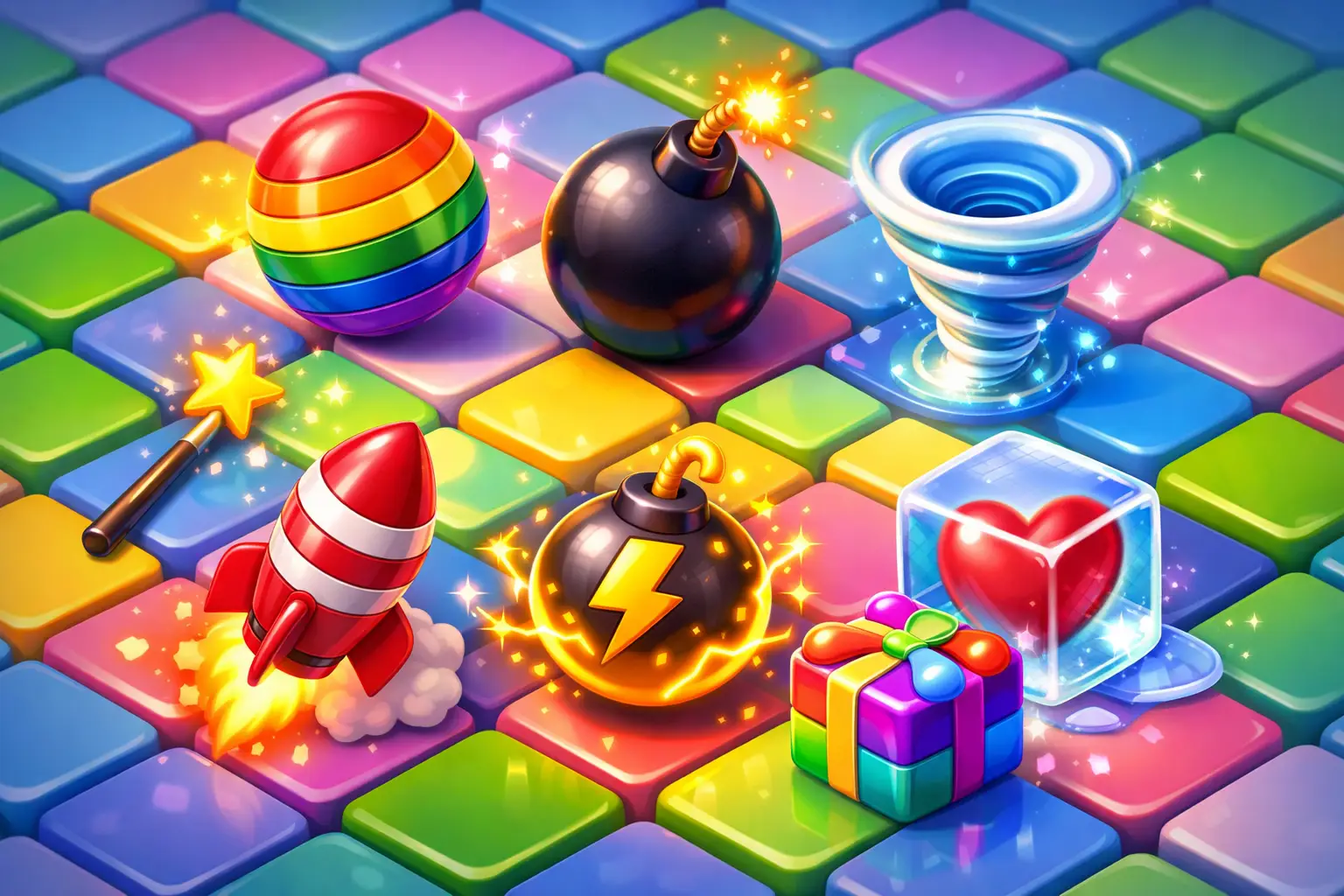
That almost-finished level is where booster choices start to matter. You have one jelly tucked behind blockers, two moves left, and a board that refuses to cooperate. In moments like that, knowing the best boosters in match 3 games is less about luck and more about timing.
Boosters are one of the most satisfying parts of the match-3 loop because they turn pressure into progress. Used well, they rescue a run, protect a win streak, and help you push through tougher worlds without making the game feel complicated. Used too early, though, they can disappear into a messy board and give you very little back. The difference is not the booster itself. It is when the board is ready for it.
What makes the best boosters in match 3
The best boosters are not always the flashiest ones. A great booster does one of three things really well: it clears awkward board spaces, breaks layered blockers efficiently, or creates enough chain reaction to change the whole level. If a booster only looks exciting but does not solve the real problem on the board, it is usually not your best play.
That is why context matters. A vertical rocket can be incredible on a tall board with locked columns, but only decent on a wide, open level. A bomb can wipe out clustered obstacles fast, but it is less valuable if your targets are spread into corners. A color-clearing booster can feel like magic on a board packed with one color, yet lose value when colors are balanced and objectives are blocker-based.
The strongest players start by reading the board objective first. Are you clearing grass, crates, vines, ice, or target tiles? Are ingredients stuck at the top? Are there narrow lanes that limit cascade potential? Once you answer that, booster value becomes much easier to judge.
The seven boosters worth relying on most
1. Rocket-type boosters
If one booster deserves universal respect, it is the rocket. Horizontal and vertical line clears are dependable, easy to understand, and useful in almost every stage of a match-3 game. They are especially strong when objectives sit in one row or column, or when blockers create narrow paths that regular matches struggle to reach.
Rockets are also excellent because they are predictable. You usually know exactly what space they will affect, which makes them safer than wider-area boosters when a board needs precise cleanup. On levels with isolated corners or long channels, that precision can be the difference between a clean win and one more failed attempt.
2. Bomb-type boosters
Bombs are often the answer when the board is clogged. They hit an area instead of a line, so they are ideal for dense blocker sections, layered obstacles, and central grid traffic jams. If a level keeps collapsing into the same congested zone, a bomb creates breathing room fast.
The trade-off is control. Bombs are strongest when your objectives sit close together. If your remaining targets are scattered all over the board, a bomb may feel powerful without being efficient. Still, for levels that punish cramped layouts, this is one of the best comeback tools you can have.
3. Color-clearing boosters
When players talk about swing turns, this is usually the booster they mean. A color-clearing booster removes every tile of one color from the board, which can instantly trigger cascades, collect hard-to-reach pieces, and set off other specials at the same time. On the right board, it does not just help. It resets the entire puzzle in your favor.
This booster gets even better when a single color is dominating the board or tied closely to the level goal. It is also a favorite for pairing with another special tile, since that combination can scatter explosive effects across multiple spaces. The only caution is that it can be less efficient against objectives hidden behind heavy blockers if color removal alone does not touch them.
4. Hammer-style single-tile boosters
The hammer rarely gets the same attention as rockets or color clears, but it wins more close levels than people expect. A single-tile hit is perfect for finishing the last crate, breaking the final chain, or tapping one stubborn corner square that the board simply will not feed.
What makes it special is accuracy. You are not hoping for a cascade. You are solving a very specific problem. That makes it one of the smartest boosters to save for late-game cleanup, especially when every move feels expensive.
5. Shuffle boosters
A shuffle booster is not glamorous, but sometimes it is exactly what a board needs. In levels where the tile layout becomes dry, trapped, or starved of useful matches, a shuffle can bring the puzzle back to life. It gives you a second chance without fully surrendering the run.
Its value depends on why you are stuck. If the issue is pure board layout, a shuffle can be a rescue. If the problem is heavy blockers or a move-efficient objective, it may only delay the real challenge. Think of shuffle boosters as reset tools, not finishing tools.
6. Extra move boosters
Not every win needs a dramatic explosion. Sometimes the strongest booster is simply more time. Extra moves are among the best boosters in match 3 because they support whatever strategy is already working. If the board is under control and you are one or two turns short, extra moves preserve momentum better than a random large effect.
They are also underrated for event play and streak protection. When rewards scale with consistency, extending a good run can be smarter than gambling on a wider-area booster that may not hit the right spaces.
7. Combo starters and pre-level boosters
Some boosters do their best work before the first move even happens. Pre-level rockets, bombs, or combo starters can break opening blockers, open tight sections, and create early cascade energy that makes the whole board easier to manage. On difficult handcrafted levels, that head start can remove the most annoying part of the puzzle right away.
These boosters shine when the first few turns are usually restrictive. If a level starts with locked zones, boxed-in tiles, or limited match options, entering with built-in pressure relief is a huge advantage. They are less necessary on open, forgiving boards where natural combos are easy to build.
When to use boosters and when to hold them
The most common mistake is spending a strong booster before the board reveals its real problem. Early turns should usually be about reading the level. You want to see where blockers refill, where cascades naturally happen, and which zones are hardest to reach. Once the board shows its pattern, your booster can target the true bottleneck.
There are exceptions. If a level is known for a brutal opening, using a pre-level booster can be the right call because it creates room before the board locks you down. Likewise, if you are protecting a win streak, spending a booster a little earlier can be worth it. Progress matters, and a saved level often pays you back through rewards, stars, and event milestones.
A simple rule helps here: use precision boosters late, use board-opening boosters early, and use high-chaos boosters when the board is already set up to multiply their value.
Smart booster combos beat random power every time
Single boosters are good. Booster combinations are usually better. A rocket and bomb together can clear a wider pattern than either one alone. A color clear combined with another special can transform ordinary tiles into a chain reaction across the whole board. Those moments feel amazing because they turn one good move into several turns of progress.
Still, not every combo is worth forcing. Chasing a fancy combination can waste moves if the level needs simpler, more direct clearing. If one isolated blocker is all that stands between you and the win, a hammer beats a complicated setup every time.
This is where experienced match-3 play becomes satisfying. You stop asking, Which booster is strongest? and start asking, Which booster solves this board with the least waste?
Picking the right booster for your level goal
If your target is blockers, bombs and opening combos usually give the best return. If the level is about reaching awkward rows or columns, rockets are the safer choice. If the board is nearly solved and one tile is ruining your day, a hammer is the clean finish. If the level keeps starving you of useful matches, shuffle. If you are close and already in control, extra moves may be the smartest spend of all.
That practical mindset is what makes boosters feel rewarding instead of random. In a game built around visible progress and satisfying wins, every smart booster use turns frustration into momentum. In a polished puzzle experience like Garden Match Puzzles, that momentum matters because each cleared level pushes your garden, collections, and event progress forward at the same time.
The best booster is the one that answers the board you actually have, not the one with the biggest animation. Play for the problem in front of you, and even the toughest level starts to feel a lot more beatable.