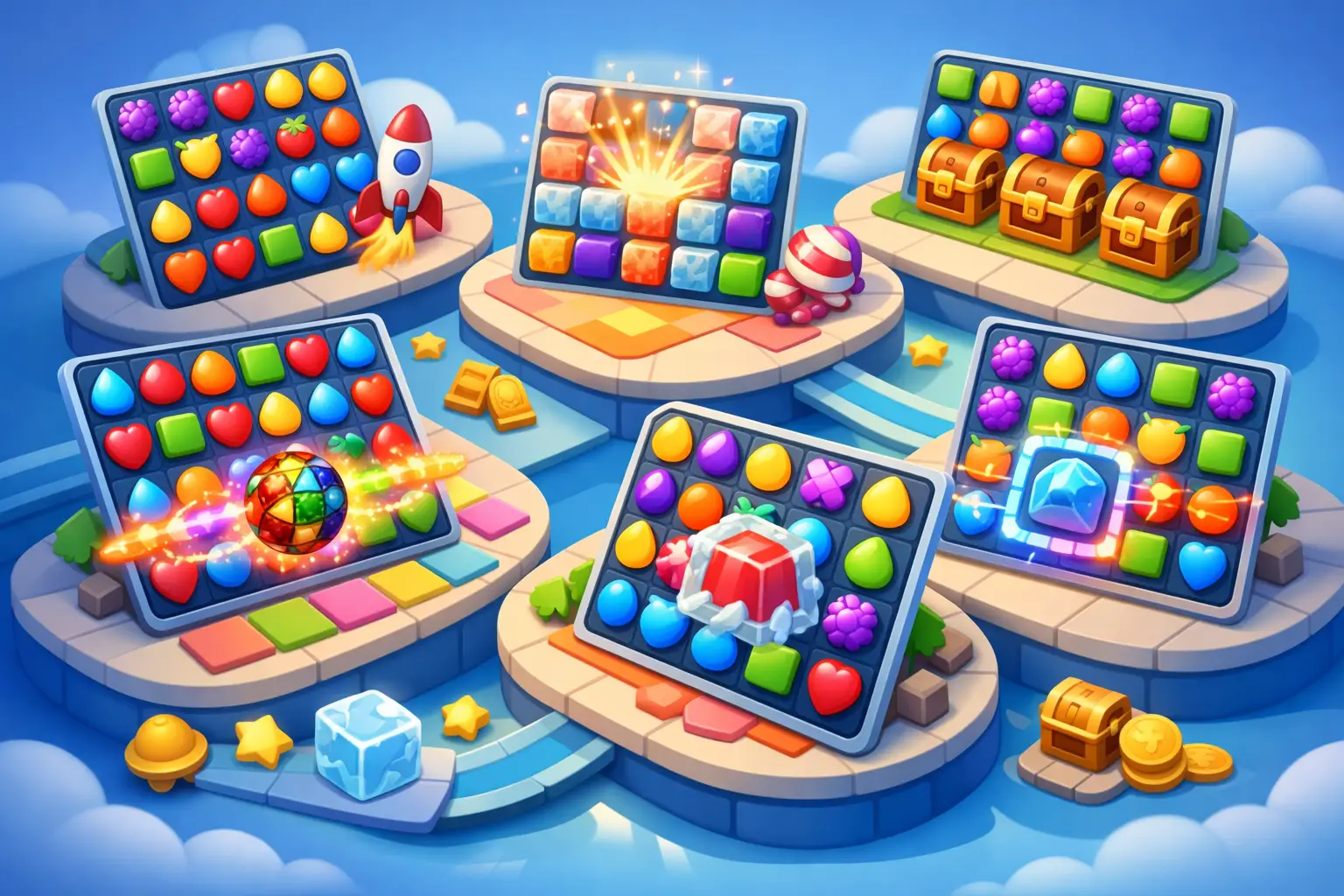
A great puzzle rarely feels difficult because the board is crowded. It feels satisfying because, after a few thoughtful swaps, you can see why a plan worked. These match 3 level design examples show how clear goals, changing board layouts, and well-timed rewards create that feeling - a small challenge with a visible path forward.
For a relaxing game, fairness is not the same as making every board easy. A fair level can ask you to think ahead, choose between two good moves, and adjust when a cascade changes the plan. What it should not do is leave you guessing what mattered or feeling that progress depended on one unlikely swap.
What Makes a Match 3 Level Feel Fair?
Players read a board in seconds. They notice the target, scan the obstacles, and look for a promising first move. Strong design respects that quick decision-making process. The main goal should be understandable before the first swap, while the board should reveal more interesting choices as pieces fall.
The best levels also vary their rhythm. Some are a calm opportunity to build a few powerful pieces. Others are compact puzzles where every move needs a purpose. Across a longer journey, those different rhythms keep a garden world feeling like a collection of distinct places rather than one board repeated a thousand times.
Here are seven designs worth studying, whether you are sharpening your own strategy or simply curious about why certain levels stay memorable.
1. The Gentle Tutorial Board
A tutorial level works best when it teaches through a win, not a lecture. Imagine a small, open board with one target: collect 12 yellow flowers. Yellow pieces appear in several easy matches, and a natural four-in-a-row happens near the center after two or three swaps.
The player learns that larger matches create a useful special piece, then sees that piece help finish the goal. No long instructions are needed because the board does the teaching. The trade-off is that this kind of level has limited replay drama, so it belongs near the introduction of a mechanic or after a more demanding stretch.
A good teaching board leaves behind a practical idea: when the next level asks for a special piece, the player already knows what one can do.
2. The Two-Path Collection Puzzle
Now picture a board with 20 leaves to clear. Ten sit in an open center area, while the other ten are tucked behind light blockers on the left and right. The central leaves are easy to reach, but clearing the side areas opens more room for cascades and creates better chances to make boosters.
This is one of the most useful match 3 level design examples because it gives the player a real decision. Do you take the visible progress in the center, or invest moves opening a side first? Neither choice is automatically wrong. A player with a strong booster can break through early, while another may build the board before committing.
The goal remains simple, but the route changes from play to play. That is depth without a complicated rulebook.
Why the board shape matters
Narrow side chambers should be used carefully. If they are too isolated, the player has few meaningful swaps and the puzzle feels stalled. If they connect to the main board through two or three entry points, clearing a blocker feels like opening a new garden bed: more space, more color, and more possibilities.
3. The Layered Blocker Level
Layered blockers are satisfying when each layer changes the board in a useful way. For example, a level might begin with a row of moss-covered stones along the bottom. Clear the first layer and a set of collection items becomes available. Clear the second layer and pieces can finally fall into a previously empty section.
The key is visible progress. Every few moves should alter the board, even if the final target is still a distance away. Small visual changes tell the player that their work is accumulating. This is especially valuable in a 10-minute evening session, when finishing a level should feel like steady cultivation, not a long wait for one perfect chain reaction.
There is a balance to keep. Too many layers can make a board visually busy and obscure the actual objective. Use them when the opening-up effect creates new choices, not simply to add more taps between the player and the finish.
4. The Corner Rescue Challenge
Corners naturally create tension because pieces cannot enter from every direction. A level with a few target tiles in opposite corners asks players to think about reach, not just match size. The center may offer plenty of attractive swaps, but a well-placed vertical booster or a special-piece combination can solve the awkward space cleanly.
This design rewards patience. It also teaches a useful habit: do not spend every special piece as soon as it appears. Sometimes the best move is to hold one for the part of the board that has the fewest options.
Corner goals need enough support to remain fair. Give players nearby colors that can be matched, or allow pieces to fall toward the corner after an adjacent area opens. A corner that can only be cleared by an exact, rare move is not a thoughtful challenge. It is a bottleneck.
5. The Countdown-Free Pressure Board
Pressure does not require a ticking clock. A move limit can create a focused puzzle while still letting players pause, look over the board, and make a considered choice. Consider a board with 18 moves to collect jars from the bottom row. The jars are reachable, but early matches at the top do little unless they create pieces that travel downward.
The puzzle asks a clear question: how will you send enough power to the bottom? A player may make vertical boosters, save a color-clearing special piece for a crowded moment, or open the lower rows first. When the board explains its own challenge, a tight move count feels purposeful rather than pushy.
A good rule of thumb is to leave room for recovery. One imperfect swap should not end the attempt. Players should still have opportunities to build a smart combination, especially when the board begins to open.
6. The Booster Invitation Level
Boosters feel best when they expand a plan instead of replacing one. A well-designed booster invitation level presents a board where a booster can create a satisfying shortcut, but ordinary play can still succeed. For instance, several blockers might form a compact cluster around the goal. A pre-level tool can open that cluster, while a player who starts without it can work around the edges and build a combination.
This approach respects different play styles. Some people enjoy saving boosters for a tricky board; others prefer to settle in and solve it swap by swap. In Garden Match Puzzles, purchases can enhance progress, but everyone can play anytime, so a level should always offer a clear route through its puzzle.
The design lesson is simple: show what a booster improves. If its value is visible, choosing to use one feels strategic. If the board appears impossible without it, the choice no longer feels like a choice.
7. The Calm Victory Lap
Not every level needs a twist. After several compact challenges, an open board with generous cascade potential can be exactly the right change of pace. Give it a friendly collection goal, a few easy-to-reach blockers, and enough space for special pieces to appear naturally.
These levels create momentum. They let players enjoy the skills they have built - spotting a five-match, setting up a combination, and watching the board bloom into a chain of useful clears. They are also an excellent place to introduce a new decorative reward or garden milestone, because the puzzle itself leaves room to appreciate the progress.
The risk is using too many in a row. A victory lap is most rewarding when it follows a hill in the path, not when every stage is flat.
Build a Better Plan From the First Swap
When you meet a new board, take one quiet moment before moving. Find the target tiles that are hardest to reach, notice which blockers will open space, and look for matches that help both. A large match is exciting, but a smaller one near the right obstacle can be the move that changes everything.
That is the lasting appeal of considerate level design: each board offers a modest puzzle, each solution leaves the garden a little brighter, and every finished level gives you one more useful idea for the next.