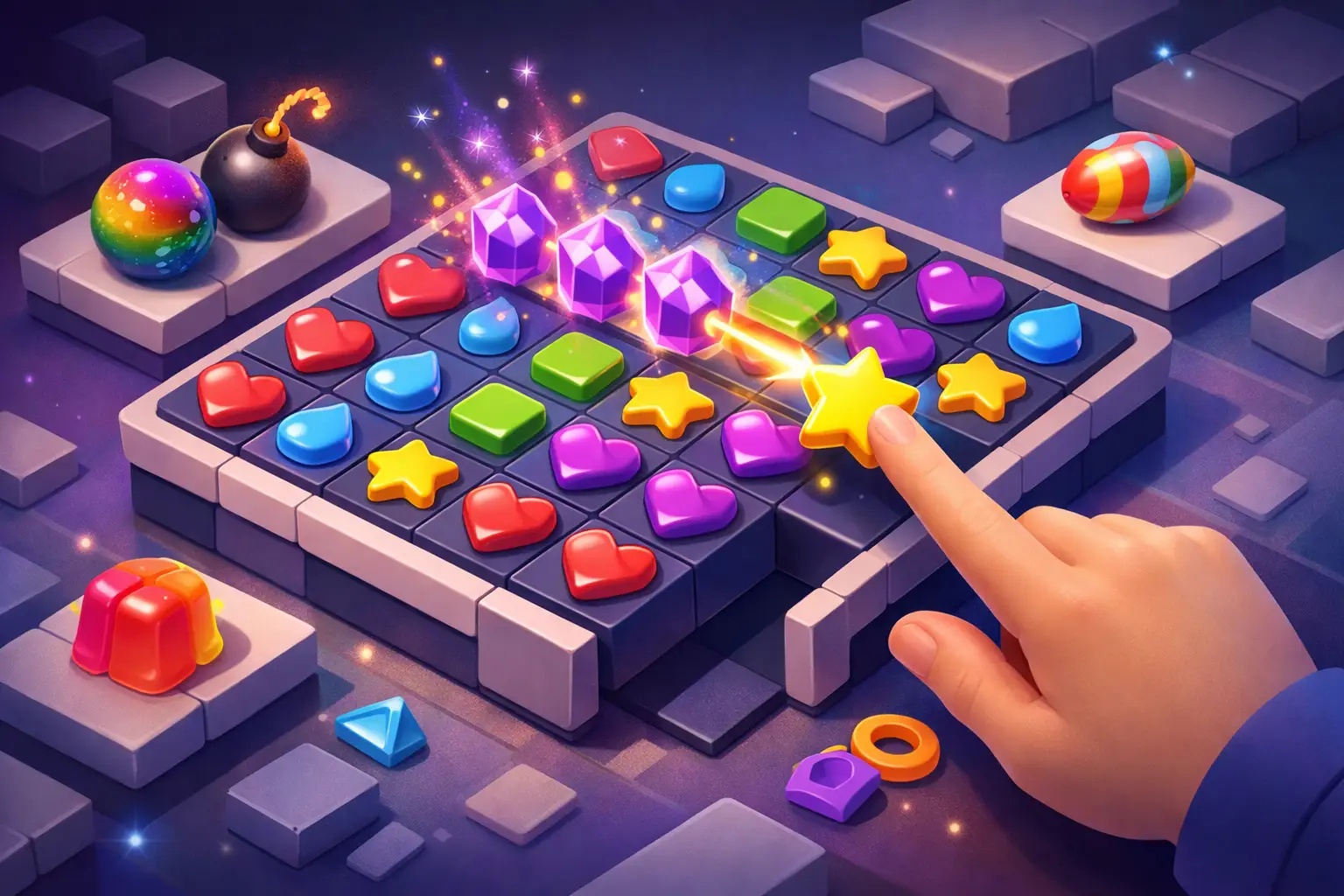
A great match-3 level can change the shape of a quiet ten-minute break. You make one swap, a row clears, a blocker cracks, and a path that looked impossible a moment ago begins to open. That feeling is not an accident. Puzzle level design is the careful work of giving each board a clear purpose, a fair challenge, and a satisfying finish.
For players, the best levels feel easy to understand but never empty. You can see what needs doing, make a plan, adjust when the board changes, and enjoy the small surprise of a well-timed cascade. The board asks for your attention, not your entire evening.
What Good Puzzle Level Design Feels Like
A memorable level starts with a question. Can you clear the flowers trapped in the corners? Can you bring the garden pieces down before your moves run out? Can you open enough space to reach the last few tiles? A focused question gives a level its identity.
The answer should not be obvious on the first move. Still, it should become clearer as you play. Maybe matching beside a crate is more useful than chasing a bright-looking combination in the center. Maybe saving a booster for the final blocked area is wiser than using it immediately. The pleasure comes from noticing what the board is asking of you.
That balance matters because relaxing does not mean effortless. A level with no decisions becomes background noise. A level with too many competing demands can feel like clutter. The sweet spot is a board that creates one or two meaningful priorities, then gives you room to solve them in your own way.
The Building Blocks of Puzzle Level Design
A clear goal gives every move a job
Goals tell you where to look. Collecting a certain color, clearing garden tiles, dropping pieces to the bottom, or removing obstacles can all work beautifully when the goal is visible and concrete.
The strongest boards connect the goal to the layout. If items need to travel downward, the board might have narrow channels that make each cleared space matter. If you are clearing tiles, protected corners can turn an ordinary matching task into a small planning puzzle. The objective is not pasted onto the board afterward. It shapes the board from the first swap.
Clarity also makes a level more welcoming when you return after a busy day. You should not need to study a screen full of rules before you can enjoy a good move. A quick glance ought to tell you what to do next, even if the best route takes a little thought.
Obstacles create texture, not confusion
Obstacles are where a familiar swap-and-match board gains character. They can slow progress, redirect your attention, protect important spaces, or reward you for making special pieces. But each obstacle needs a readable role.
A simple blocker may ask for one adjacent match. A layered obstacle may need repeated attention, which makes it a good fit for a central area that stays relevant across several turns. Something that spreads or shifts can add motion, but it needs enough room and enough visual contrast that players can follow what changed.
Placement is just as important as the obstacle itself. A single blocker near a key route can be more interesting than a board packed wall-to-wall with them. Open spaces create opportunities for cascades and special pieces. Tighter spaces create decisions. Moving between those two conditions gives a level rhythm.
Move counts set the mood
The number of moves is not simply a difficulty dial. It changes how a level feels. A generous move count invites experimentation. A tighter count makes planning and special-piece combinations more valuable.
Neither approach is always better. Early in a new mechanic, extra room helps players learn its behavior without pressure. Later, a more compact move count can make a familiar idea feel fresh again. The key is that a close finish should feel earned, not mysterious. Players should be able to recognize the choices that brought them close and see a different route worth trying next time.
Fairness also means respecting the board's natural unpredictability. Cascades are part of the joy of match-3 games, but a good level does not depend on one unlikely chain to be possible. Smart choices should improve your odds consistently, even when the board has its own surprises.
Why Board Shape Matters More Than It Seems
Two levels can use the same goal and obstacles yet feel completely different because of their shape. A wide, open board encourages combinations. A board split into islands makes access the central problem. A slim vertical layout emphasizes downward movement, while pockets at the edges ask you to plan how to reach them.
Good board shapes create moments of change. At first, a blocked-off section may feel distant. After a few matches, it connects to the main play area, and suddenly new possibilities bloom. This is satisfying because the player can see the result of their work. The board becomes more playable through choices they made.
Symmetry can be calming, especially in an early level where the goal is learning. Asymmetry can be useful when a designer wants to establish priorities. One difficult corner may quietly tell you where to focus first. The choice depends on the lesson and the mood, not a fixed formula.
Special Pieces Should Reward Attention
Special pieces are most satisfying when they are a result of something you noticed and planned. A four-match, a T-shaped pattern, or a combination of two powerful pieces should feel like a small reward for seeing beyond the nearest match.
Level design can support that without making the answer too obvious. Open areas naturally create more matching possibilities. Obstacles arranged in clusters can make a blast effect especially useful. A blocked channel may encourage you to save a line-clearing piece until it can do real work.
The best moments often come from restraint. If every move produces a huge effect, the board loses contrast. If powerful combinations arrive occasionally at exactly the right time, they feel memorable. A level needs calm turns as well as fireworks.
A Gentle Difficulty Curve Builds Trust
Across a long game, difficulty should rise and fall like a garden path rather than a wall. A new obstacle deserves an introduction where its behavior is easy to read. A few levels later, it can appear alongside a familiar challenge. Later still, the combination can become the heart of a more demanding board.
Breather levels matter, too. After a tricky layout, a more open board lets players enjoy the skills they have developed. That does not make it filler. It gives progress a shape. You recognize that you are better at making special pieces, reading routes, or choosing which obstacle to clear first.
At Garden Match Puzzles, hand-crafted levels make room for this kind of pacing across themed worlds. One world can introduce a new visual idea and play pattern; the next can build on it with a different layout and fresh garden goals. The result is variety that still feels familiar enough to settle into.
Design for a Real Life Session
Most players do not sit down with a spreadsheet and an uninterrupted afternoon. They play while waiting for an appointment, on the train home, or as a small ritual before bed. Puzzle level design should respect that context.
This means the first few moves need to be readable. It means a level should offer satisfying progress even when it takes more than one attempt. It means the board should not hide essential information behind visual noise. A player who has five minutes deserves a complete, enjoyable puzzle experience, whether they clear one level or several.
It also means keeping challenge separate from pressure. Thoughtful play is more rewarding when you can pause, consider the board, and return whenever you are ready. Purchases can enhance progress for players who choose them, but the core pleasure remains the same: seeing a board clearly, making a smart swap, and watching your plan take root.
The Best Levels Leave Room for Your Own Solution
A hand-crafted level is not a script with one correct sequence. It is a thoughtfully arranged space where several good choices can lead forward. One player might clear the center first to make room for combinations. Another might work the edges and release a trapped objective early. Both approaches can be satisfying when the board responds clearly.
That freedom is what keeps a simple mechanic interesting over hundreds of levels. You are not merely repeating a gesture. You are deciding where to invest a move, when to hold a special piece, and which small opening can become a bigger one.
The next time a stubborn corner finally clears or a saved combination reaches exactly the right spot, take a second to enjoy it. That small burst of progress is a bloom worth noticing.