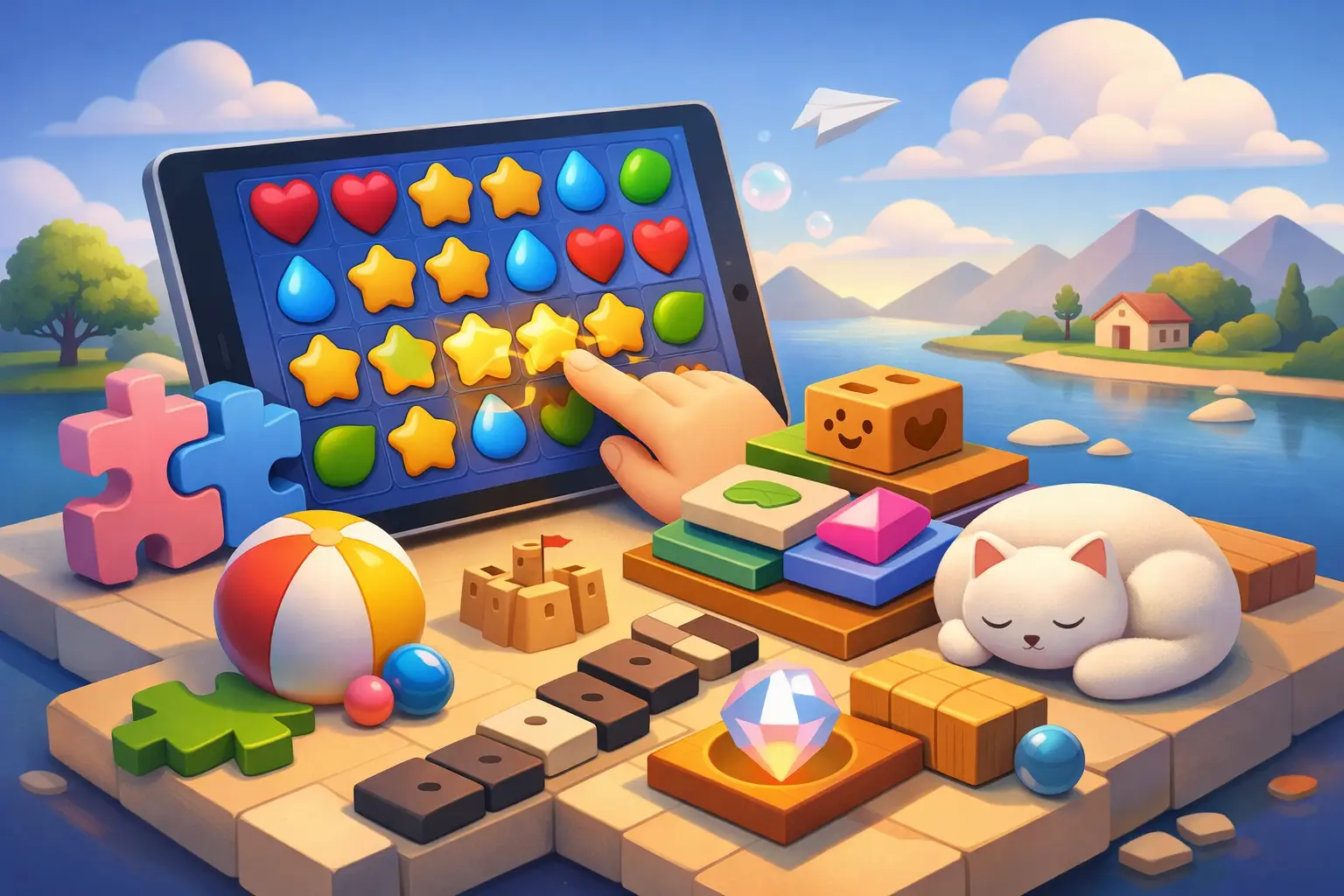
Some puzzle games ask for your full attention when you barely have ten quiet minutes to spare. Others understand the assignment. A relaxing casual puzzle game should lower the noise, give you something satisfying to solve, and leave you feeling a little more settled than when you started.
That sounds simple, but it’s surprisingly rare. Plenty of games are easy to learn. Fewer are truly relaxing once you’ve spent a week with them. The difference usually comes down to how the game handles pace, progress, challenge, and reward.
A relaxing casual puzzle game should feel calm, not flat
Relaxing does not mean boring. The best puzzle games still give your brain something to do. You notice patterns, make small decisions, and enjoy those tiny moments when one smart move clears the board in exactly the way you hoped.
What changes is the emotional temperature. A calm game does not punish every mistake or make each session feel like a test. It gives you room to think. It lets satisfying moments bloom naturally instead of forcing constant intensity.
That balance matters for adults who play in short windows - during a commute, between errands, or at the end of the night when concentration is lower and patience is thinner. In those moments, a game has to be welcoming on contact. If it takes too much effort just to get settled in, it stops being a wind-down habit and starts feeling like another demand.
Why short sessions matter more than people admit
Most players are not sitting down for a two-hour puzzle marathon on a Tuesday. They are opening a game for five minutes while coffee brews or for fifteen minutes before bed. A relaxing casual puzzle game needs to work beautifully at that scale.
That means quick load-in, clear goals, and a board state you can read at a glance. It also means each session should produce visible progress, even when it is modest. Maybe you clear four levels. Maybe you finish one tricky board, collect a daily reward, and place a new flower bed in your garden. Small steps still count when they are tangible.
This is one reason decorative progression works so well in the category. Solving puzzles is satisfying in the moment, but seeing your space grow over time gives those sessions a second layer of meaning. You are not only clearing tiles. You are also building something that reflects your choices.
The puzzle itself has to be easy to read
For many players, relaxation begins with clarity. If a board looks cluttered, if the objectives are hard to parse, or if too many effects fire at once, the game creates friction before the first move.
A well-designed casual puzzle game teaches its rules quickly and then keeps building on them in clean, understandable ways. You should know what matters on the board, what your best opportunities are, and why a move worked. Even when a level is challenging, the logic behind it should feel fair.
That fairness is a bigger part of relaxation than it might seem. Players can handle difficulty. What wears them down is confusion. When a loss feels arbitrary, the session ends on irritation instead of satisfaction.
Good challenge has texture
There is a common mistake in puzzle design: assuming that relaxing players only want easy wins. In practice, many adult players enjoy a game more when it asks for a little thought. The trick is giving challenge texture rather than just pressure.
A good level might ask you to decide whether to open space at the bottom of the board first or combine two power pieces for a larger clear. It might reward planning without requiring perfect foresight. It can be tricky, even stubborn, but it should still feel readable and worth another try.
That kind of challenge creates a gentle sense of mastery. You begin to recognize patterns. You start using boosters more intentionally instead of automatically. Every swap feels amazing because it comes from understanding, not button mashing.
For experienced players, this is often the difference between a game that lasts a weekend and one that becomes part of a routine. Depth without complexity is the sweet spot. The puzzle remains approachable, but your decisions keep gaining weight as you go.
Rewards should feel steady and concrete
Relaxation is easier when progress is visible. A game does not need to throw fireworks at every tap, but it should acknowledge your time in real ways.
The most satisfying reward loops tend to be layered. You clear a level and earn coins or boosters. You complete a string of levels and open a new stretch of world map. You finish a set of objectives and add new blooms, paths, or decorations to your garden. Over a week, those pieces accumulate into something you can actually see.
Concrete progress matters more than exaggerated praise. Players know the difference between a genuine reward and a loud animation covering an empty result. If you cleared 47 levels this week and added 12 new blooms to your garden, that feels meaningful on its own.
A relaxing casual puzzle game needs room to grow
One of the best qualities in this kind of game is longevity. Not endless complication, but enough fresh content and variety to keep the routine from going stale.
That can come through themed worlds, new level layouts, collectible sets, seasonal touches, or alternate modes that change your usual rhythm. The important part is that these additions support the core experience instead of distracting from it. A side feature should feel like a pleasant branch, not a demand for extra attention.
When this is done well, the game grows with the player. Early on, you enjoy the immediate puzzle loop. Later, you begin caring about your garden design, your collection progress, your team contributions, or how efficiently you clear certain level types. The roots deepen without making the surface harder to enjoy.
Social features work best when they stay light
Not every relaxing game needs social systems, but gentle connection can add warmth when it is handled carefully. Co-op play, team goals, or leaderboards can be motivating as long as they do not turn every session into a performance.
For many adults, the appeal is simple: it is nice to play alongside other people without feeling pushed by them. You can contribute when you have time, celebrate shared progress, and still keep the experience mostly your own.
That is a subtle design choice, and it matters. Relaxation disappears quickly when social features become noisy or demanding. The best versions feel more like a neighborhood garden club than a contest.
Presentation shapes the mood more than mechanics alone
Players often describe a game as relaxing because of the feeling it creates before they make a single move. Color palette, sound design, animation speed, and interface layout all do quiet but important work.
Soft visual themes help, but they are not enough by themselves. A game can look cozy and still feel exhausting if menus are crowded or pop-ups constantly interrupt the flow. True comfort comes from restraint. The screen should feel organized. Effects should reward a good move, not drown it.
Music and sound matter too. The best audio in a puzzle game supports focus instead of trying to dominate it. Gentle chimes, crisp match effects, and warm ambient tracks can turn a five-minute break into a real reset.
What players are really looking for
When people search for a relaxing casual puzzle game, they are usually not searching for the easiest one available. They are looking for a game that respects their attention. Something they can learn quickly, return to easily, and enjoy without needing to brace themselves first.
That is why thoughtful design tends to outlast flashy design. A clear board, smart level craft, steady rewards, and a sense of growth will carry a game much further than noise ever could. Garden Match Puzzles leans into that idea with handcrafted levels, visible garden progress, and the kind of layered play that stays calm even as it gets richer.
The best puzzle habit is the one you look forward to opening again tomorrow - not because it shouts the loudest, but because it leaves your mind a little clearer and your garden a little fuller.