Some puzzle stages blur together so completely that you forget them the moment they end. Others have shape. You remember the awkward corner that forced a better move, the moment a blocker finally cracked open, or the board that looked impossible until the pattern clicked. That difference usually comes down to handcrafted puzzle levels.
For players who want a match-3 game to feel relaxing but still worth their attention, level design matters more than flashy effects or oversized reward screens. A well-built board gives you a clear problem, enough room to think, and a satisfying sense that your choices changed the outcome. Every swap feels better when the level has been arranged with care.
What handcrafted puzzle levels actually mean
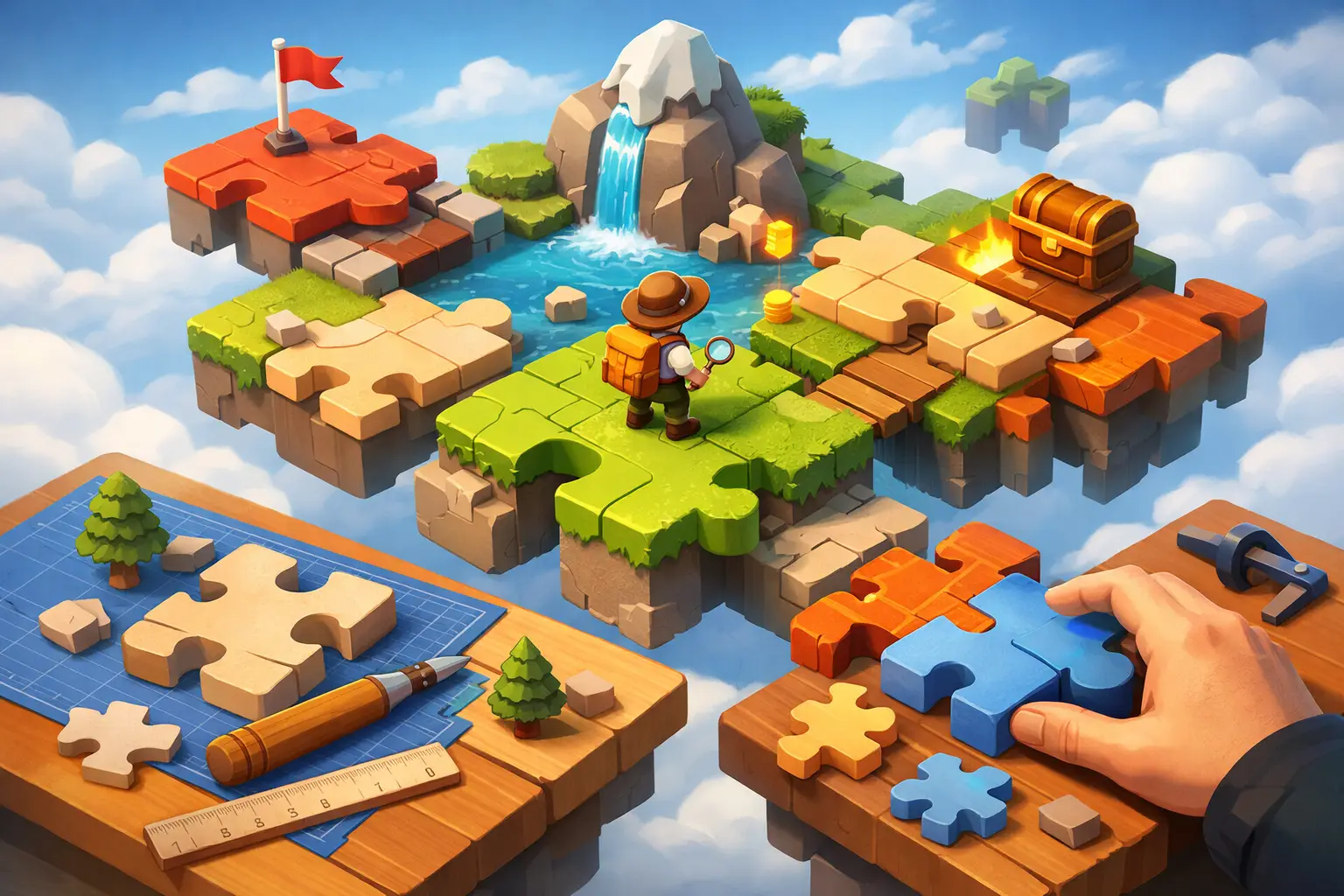
A handcrafted level is built intentionally, not just generated from a formula and dressed up with a new background. The designer decides where blockers go, how space opens up, which early moves teach the board, and how the win condition should feel from start to finish.
That does not mean every level needs to be brutally clever or packed with tricks. In a good mobile puzzle game, handcrafted design often feels invisible. The board simply makes sense. It gives you a clean first impression, a few promising paths, and enough variation to keep the next stage from feeling like a repaint of the last one.
This is especially important in games played in short sessions. If you have ten minutes before bed or a few quiet minutes between errands, you do not want to spend half that time deciphering a messy board that never settles into a readable challenge. Hand-built levels respect that rhythm. They get to the point faster.
Why handcrafted puzzle levels feel more satisfying
The biggest advantage is pacing. A handcrafted board can create a small arc inside a single level. Early moves may focus on opening the center. Midway through, the board shifts and asks you to choose between chasing the objective or setting up a stronger combo. The final turns often tighten naturally, so the finish feels earned instead of random.
That pacing creates a better emotional texture. Some levels should feel breezy. Some should ask for a second try. Some should reward patience more than speed. When every board is made with a distinct purpose, the game can alternate between gentle progress and more thoughtful challenge without becoming dull.
There is also a stronger sense of fairness. Players can usually tell when a loss came from a board they did not fully read yet, versus a board that never offered meaningful decisions. Handcrafted design leans toward the first kind of loss. You restart with a better idea, not with irritation.
Fairness matters even more over hundreds of levels. Adults who use puzzle games as a daily wind-down habit are not looking for constant friction. They want a game that can surprise them without wasting their attention. A carefully designed level says, in effect, we thought about how this should play before asking for your time.
The quiet craft behind a great board
Good handcrafted design starts with readability. At a glance, you should be able to understand the board's main tension. Maybe pieces are boxed into the corners. Maybe a narrow central channel controls the whole stage. Maybe the objective sits behind layered blockers that need planning rather than luck.
Then comes move quality. Strong levels offer several reasonable first moves, but they are not all equal. That is where strategy begins. You can chase an immediate match, open space for future cascades, or build toward a booster combination. The board supports choice without becoming chaotic.
The best stages also manage space carefully. Open boards usually create a lighter, faster feel. Tighter layouts with separated sections ask for more deliberate play. Neither is automatically better. It depends on the purpose of the level and what came before it. Variety works when each board has a reason for being shaped the way it is.
Finally, handcrafted levels need a good finish. Some boards collapse into a satisfying final sequence once the main obstacle breaks. Others stay tense until the last few moves. Both approaches work, but the ending should feel connected to the original challenge. If a level begins with a clever setup and ends in noise, the board loses some of its character.
Why this matters more in match-3 than people think
Match-3 is easy to learn, which sometimes causes people to underestimate how much design work sits underneath it. Swapping pieces is simple. Building hundreds or thousands of boards that stay readable, varied, and rewarding is not.
In fact, simple mechanics make level design more important, not less. When the rules are instantly understandable, players notice board quality faster. They can tell when a challenge is asking them to think in a fresh way. They can also tell when a level is padded, overcluttered, or leaning too hard on chance.
Handcrafted puzzle levels give simple mechanics room to bloom. A familiar move set starts producing different kinds of decisions depending on layout, blockers, goals, and turn pressure. That is where long-term depth comes from. You are not memorizing a complicated system. You are learning how the same core tools behave in different garden beds.
The trade-off: handcrafted does not always mean harder
There is a common assumption that hand-built levels are valuable only when they create serious challenge. That is too narrow. A thoughtful easy level can be just as handcrafted as a difficult one.
Sometimes the goal is to teach a mechanic without a tutorial feeling bolted on. Sometimes it is to let players recover momentum after a denser world. Sometimes it is to create a pleasant run of progress, where you clear several levels in one sitting and watch your garden pick up a few new blooms along the way.
Difficulty still matters, of course. If every board folds on the first try, the game loses texture. But difficulty works best when it arrives with purpose. A strong handcrafted curve introduces friction in places that feel natural, then gives players space to enjoy what they have learned.
That balance is especially good for people who play in bursts. One evening you may want a level that asks for careful setup. The next morning you may just want to clear three boards with your coffee. A game built around hand-designed pacing can support both moods.
How players can spot handcrafted level design
You do not need to study board theory to notice it. Usually, you feel it in the first few minutes.
A handcrafted level often has a memorable hook. Perhaps the objective sits in an awkward lane that changes how you approach the whole board. Perhaps one small section looks unimportant until you realize it controls your best combos. Those details make levels distinct.
You will also notice cleaner learning. When you fail, the reason is legible. You might realize you opened the wrong side first, spent too many moves chasing low-value matches, or missed an opportunity to combine boosters in the center. The board teaches through play instead of through scolding.
And over time, the worlds themselves feel better paced. A good sequence of handcrafted puzzle levels does more than deliver isolated stages. It creates rhythm. One world may emphasize spread and flow, while the next leans into tighter spaces and layered objectives. That sense of progression is part of the craft.
At Garden Match Puzzles, that care shows up across 1,000 hand-crafted levels, which is why progress feels steady rather than mechanical. You are not just moving through content. You are moving through boards with their own shape, tempo, and small surprises.
Why thoughtful design keeps a game cozy
Cozy does not mean empty. It means the challenge fits the mood you came for. Handcrafted puzzle levels help create that fit because they can be tuned to feel engaging without becoming noisy or exhausting.
That matters for adults who treat mobile games like a daily ritual. The right puzzle can settle your attention, give you a clear short-term goal, and leave you with the pleasant sense that you spent your time well. Clear a few boards, collect a few rewards, place a few decorations, and your progress feels concrete.
When level design is careless, all of that starts to fray. The board asks too little or too much. Success feels automatic, or failure feels arbitrary. Either way, the calm rhythm disappears.
A handcrafted board lands in the middle. It gives you enough resistance to stay interesting and enough clarity to stay comfortable. That is a small design achievement, but over hundreds of sessions, it becomes the whole reason a puzzle game keeps its place on your home screen.
The best casual games are not trying to overwhelm you. They are trying to give each spare pocket of time a little structure, a little color, and a little forward motion. When the levels are crafted by hand, you can feel that intention in every move.