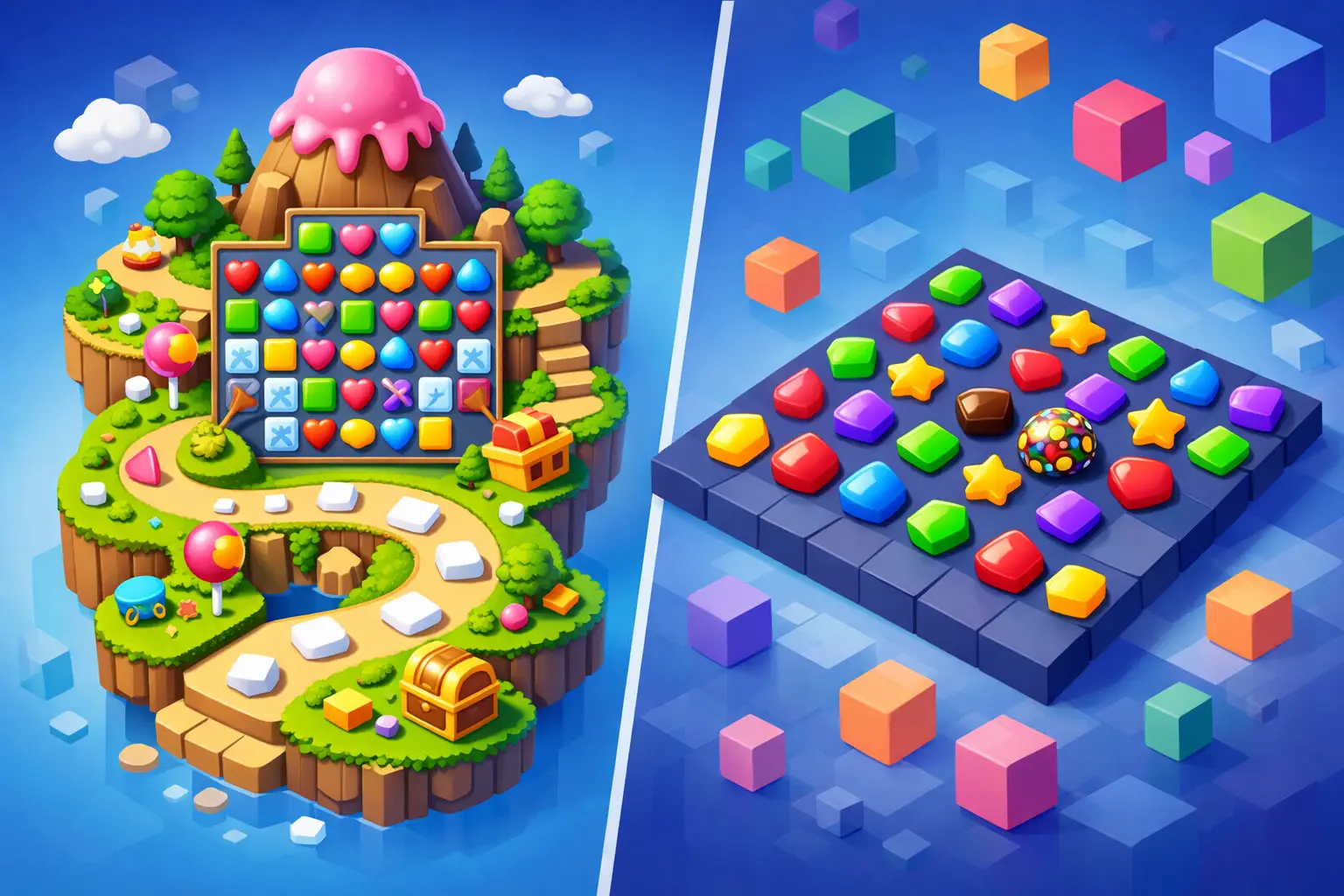
You have ten quiet minutes before bed. You clear a few flowers, set up a striped piece, and make the final move with one turn left. That feeling is where handcrafted levels vs random boards becomes more than a design debate. It determines whether a match-3 session feels like a small, satisfying bit of problem-solving or a sequence of swaps that could have happened anywhere.
For players who return to a game between errands, on the commute, or at the end of a full day, thoughtful level design has real value. A good puzzle does not need to be complicated to give your attention something worthwhile to do. It simply needs to make each choice feel like it mattered.
Handcrafted Levels vs Random Boards: The Real Difference
A handcrafted level is built around a specific idea. A designer chooses the board shape, places obstacles with purpose, sets the move count, tests possible openings, and adjusts the goal until the level has a clear rhythm. You might need to open a narrow path before collecting enough blooms, or save a booster-producing match for a stubborn corner of the board.
A random board, by contrast, relies more heavily on layouts or conditions generated from a pool of possibilities. That can create variety, especially when you have already played a familiar challenge several times. But it can also make the experience less predictable in ways that are not always interesting. One starting board may offer several smart options; another may provide very few until the pieces happen to fall into place.
Neither approach is automatically good or bad. The question is what kind of experience a game is trying to create. If the goal is a relaxing daily puzzle with satisfying progress, handcrafted design gives the team more control over the moments that matter.
A level can teach without stopping the fun
The best handcrafted boards introduce one idea at a time. Early in a new world, you may meet a new obstacle in a forgiving layout. A few levels later, it appears beside a familiar blocker, asking you to combine two skills you have already practiced. By the time the challenge becomes more demanding, it feels earned rather than abrupt.
That progression is easy to miss when it is working well. You are not reading a lesson or studying a rulebook. You are noticing that clearing pieces near the bottom creates more useful cascades, or that a wrapped-and-striped combination can reach a goal tucked behind barriers. The puzzle teaches through play.
Random layouts can present those same pieces, but they have a harder time controlling the order and clarity of the lesson. When every board begins differently, it is more difficult to know whether a hard moment came from a choice you could improve or from an especially awkward arrangement.
Difficulty has a shape, not just a number
A move limit alone does not make a level challenging. The more interesting question is where the pressure appears. Does the board ask you to spot the key obstacle? Does it reward patience for two turns? Does it leave room for a comeback after an imperfect opening?
Handcrafted levels can create that shape deliberately. A designer can build a promising first move, a turning point in the middle, and a final stretch that feels exciting without becoming chaotic. Sometimes the correct answer is a careful three-piece match. Sometimes it is holding back until you can make a powerful combination. Variety comes from changing the question, not merely shuffling the pieces.
That is especially useful for adult players who want a game that respects a short session. You should be able to put the game down after one level and remember what made it satisfying. A board that feels entirely interchangeable is less likely to leave that impression.
Where Random Boards Earn Their Place
Randomness is not the enemy of a great match-3 game. It is part of what keeps every swap lively. Falling pieces create surprises, cascades can turn a sensible plan into a spectacular one, and a fresh daily challenge can offer a pleasant change of pace.
Random boards work best when replayability is the point. A daily puzzle, an optional challenge, or a score-focused mode can benefit from starting conditions that change. The player is invited to adapt rather than memorize. That can be a fun test of observation, particularly for experienced players who enjoy finding value in an unfamiliar layout.
The trade-off is consistency. A fully random board can occasionally create a wonderful puzzle, but it may also create a session that feels flat or unusually dependent on favorable drops. A carefully designed game can use randomness inside a level while keeping the level's central idea intact. The pieces may fall differently each time, but the path to success still makes sense.
What Thoughtful Design Feels Like in Your Hands
Good level design is often felt before it is named. You notice it when a goal is visible enough to plan around. You notice it when an obstacle is frustrating for a moment, then satisfying to remove. You notice it when a booster helps you make a decision rather than simply erasing every decision.
A handcrafted board also makes small victories more meaningful. Clearing one difficult patch can open the whole garden bed. A match you set up three moves earlier can become the reason you finish with room to spare. These are modest moments, but they add up over a week of play. You cleared 47 levels because you learned their patterns, adapted your approach, and found your own useful habits.
At Garden Match Puzzles, that sense of steady progress is built into 1,000 handcrafted levels across 45 themed worlds. Each world can introduce fresh scenery, goals, and puzzle ideas while keeping the core swap-and-match play instantly familiar. Your garden grows alongside that progress, with new blooms and decorations that make the time you spend feel visible.
Why Fairness Matters More Than Perfect Predictability
Players do not need every board to be easy, and they do not need every result to be guaranteed. A little uncertainty is part of the pleasure. The key is feeling that a level gives you a fair chance to read the board, make a plan, and improve on another attempt.
Fairness comes from clear goals, understandable tools, and difficulty that has a reason. If a board asks you to clear tiles in far corners, it should offer ways to reach them. If a new obstacle changes your usual strategy, the game should give you time to see how it works. When you use a booster, its benefit should be easy to understand and satisfying to place.
This is also why play-anytime design matters. A challenging level can be a welcome puzzle when you are free to try another approach at your own pace. Optional purchases can support development and speed up cosmetic progression, but they should never decide whether you get to continue your garden story.
The Best Boards Leave Room for You
Handcrafted does not mean every move is scripted. A well-made level leaves space for personal style. One player might prioritize clearing the board from the bottom for bigger cascades. Another might build special pieces near the goal and wait for a combination. Both approaches can work because the board has enough structure to reward planning and enough movement to stay surprising.
That balance is what turns a simple match into a hobby you can return to. The rules remain approachable, yet the decisions keep changing. Some evenings call for one quick win. Others invite you to settle in, experiment with a tricky board, and enjoy the moment when the final obstacle disappears.
The next time a level makes you pause before your first swap, give it a second look. If the board is asking a clear question and leaving room for your answer, you have found the kind of puzzle that can keep blooming long after the first match.