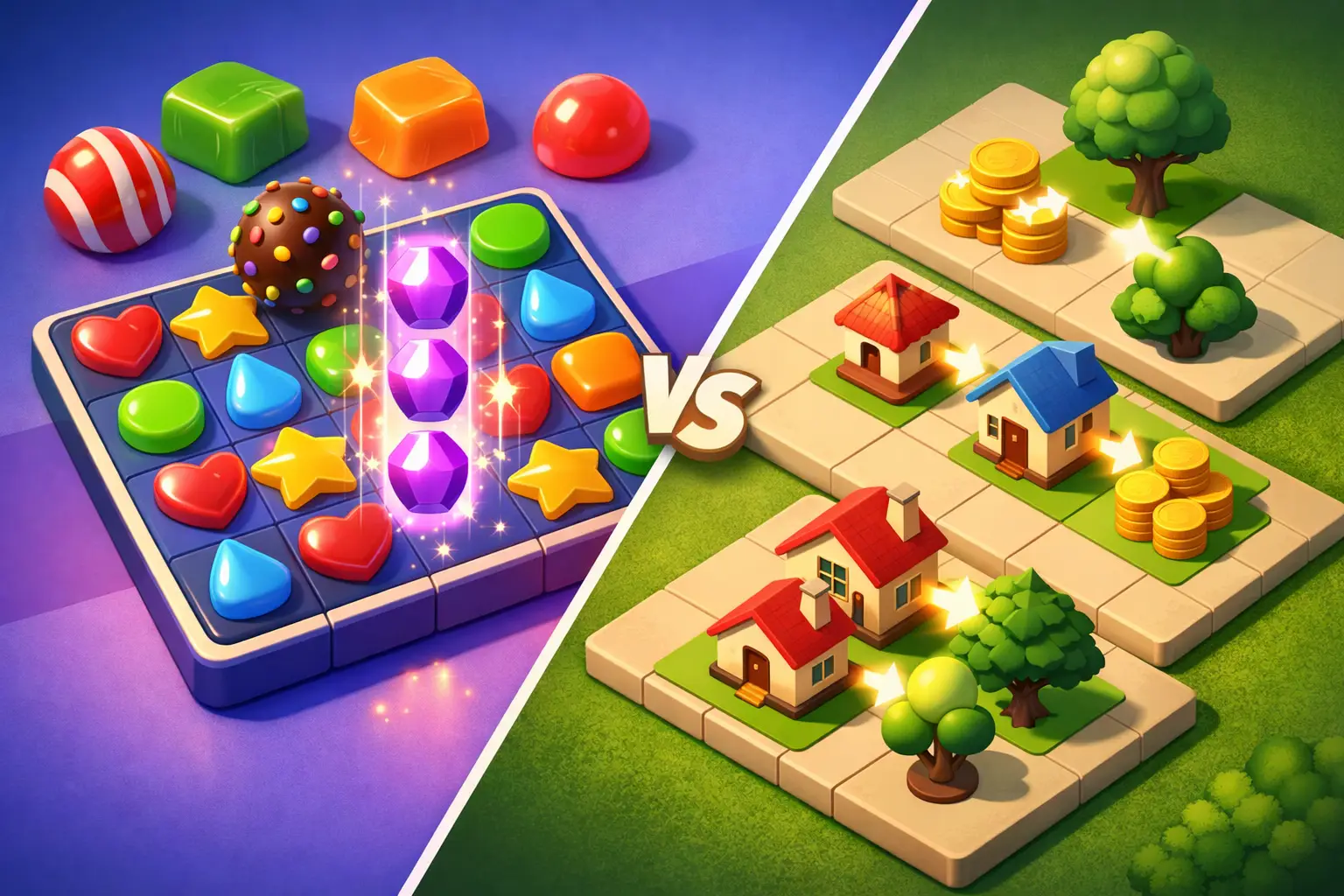
Some puzzle games ask you to react in the moment. Others ask you to set things up, wait, and watch a board slowly bloom. That difference is at the heart of match 3 vs merge games, and it matters more than it first seems when you are choosing something to play during a coffee break, on the train, or right before bed.
Both formats are easy to learn. Both can be satisfying for years. But they create very different rhythms, and rhythm is what often decides whether a game becomes part of your daily routine or gets deleted after a week.
Match 3 vs Merge Games at a Glance
Match-3 games are built around direct action. You swap pieces, create combinations, clear goals, and see the board change right away. Every move carries a small decision. Sometimes you play for one more level because you were one tile away from a great combo. Sometimes you stop after clearing five quick stages and feel like you made real progress.
Merge games usually move at a gentler pace. Instead of swapping neighboring pieces, you combine matching items to make a higher-level object. The pleasure comes from growth over time. A seed becomes a sprout, then a bloom, then something rarer. That can feel calming and orderly, especially if you like collecting, decorating, and watching a space evolve piece by piece.
Neither approach is better in a universal sense. The better fit depends on what kind of attention you want to give and what kind of reward feels good at the end of a session.
What Match-3 Games Do Best
The strongest match-3 games feel crisp from the first move. You see a board, spot a chance to line up three, and the game answers immediately. That quick feedback is a big reason the format works so well for adults who play in short windows. A five-minute session can still contain a full beginning, middle, and end.
There is also more tactical texture in match-3 than people sometimes give it credit for. On the surface, it is simple. Underneath, you are weighing move efficiency, board shape, obstacle removal, and the value of holding out for a stronger combination. A level with vines, crates, or blocked corners asks a different kind of thinking than an open board built for combo chains.
That makes progress feel earned in a concrete way. You did not just wait for an item to mature or merge enough copies over time. You solved something. Even when the puzzle is light and welcoming, there is still a small spark of accomplishment in every clean clear.
For players who like layered progression, match-3 also tends to pair naturally with broader systems. Decorating a garden, collecting rewards, joining a team, or moving through themed worlds all benefit from that steady level-by-level structure. You can look back and say, "I cleared 18 levels this weekend and added a new section to the garden," and that progress feels visible.
Where Merge Games Shine
Merge games offer a different kind of satisfaction. They are less about finishing a tightly designed puzzle and more about shaping a board over time. If match-3 feels like solving, merge often feels like tending.
That slower loop can be a real strength. Some players do not want every move to carry pressure. They want to combine items, open space, and build toward larger goals without the stop-start pattern of individual levels. Merge games can be especially pleasant if you enjoy organization, collecting, and seeing chains of transformation unfold.
They also give you more room to set personal priorities. You may decide to focus on one item line, clean up your board, or save materials for a bigger merge later. That freedom is appealing, but it comes with a trade-off. Because the structure is looser, sessions can sometimes feel less defined. You may spend ten minutes arranging pieces and still feel like you are halfway through the task you started.
For some players, that is the appeal. For others, it creates a faint sense of drift.
Pace Is the Real Deciding Factor
If you are choosing between these genres, pace is usually more important than theme. A garden, bakery, town, or fantasy setting can all be charming. What matters day to day is how the game feels in your hands.
Match-3 tends to suit people who want clean session boundaries. Start a level, make decisions, finish the objective, move on. Even when progression systems get richer, the core loop stays legible. You always know what success looks like for the next few minutes.
Merge games are better for players who enjoy open-ended maintenance. The board is rarely fully solved. There is always another item to combine, another chain to advance, another patch to tidy up. That can be relaxing if you like a low-pressure companion game you can return to throughout the day.
This is why match 3 vs merge games is not really a question of complexity. It is a question of tempo. Do you want short puzzle arcs with clear wins, or a longer, softer progression curve that accumulates over time?
Strategy Feels Different in Each Genre
People often assume merge games are more strategic because the board can become crowded and planning ahead matters. There is some truth to that. Spatial management is a real skill. Deciding what to combine now, what to hold, and what to sacrifice later can shape the whole session.
But match-3 strategy is sharper in a different way. Good level design asks you to read the board, adapt to random piece drops, and choose between immediate progress and stronger setups. One move can remove blockers, charge a power-up, or create a chain reaction that changes the rest of the puzzle. The decisions are faster, but they are not shallower.
For experienced puzzle players, that difference is important. Merge strategy often rewards patience and organization. Match-3 strategy rewards pattern recognition and efficient choices under light constraints. Both are satisfying, but they scratch different itches.
Which Genre Is More Relaxing?
That depends on what relaxes you.
If relaxation means gentle repetition, low stakes, and a board you can fuss over at your own pace, merge games may be the better match. They can feel almost meditative when the item chains are easy to read and the progression is steady.
If relaxation means finishing something, checking off a goal, and ending a session with a small sense of completion, match-3 often wins. A well-tuned level gives your attention a place to land. You focus, you solve, you move on. For many adults, that is a better form of winding down than open-ended management.
There is also the question of mental clutter. Merge boards can become busy. For some players, that visual density is part of the fun. For others, it starts to feel like digital housekeeping. Match-3 boards usually reset that feeling every level, which keeps the experience fresh.
Why Match-3 Often Has More Long-Term Variety
One reason players stay with match-3 for months or years is that the format supports handcrafted variety especially well. A level can introduce a new obstacle, a fresh board shape, or a goal that changes how you think about every move. That gives designers room to surprise players without making the game harder to understand.
Merge games tend to deliver variety through new item chains, events, or map expansion. That can be enjoyable, but the moment-to-moment interaction is often more consistent. If you love the core loop, that consistency is comforting. If you want each session to feel distinct, match-3 usually has the edge.
That is part of why games built around thoughtful level design remain so replayable. In a strong match-3, every swap feels amazing because the board answers in a way that is both readable and alive. You are not just accumulating materials. You are making choices that matter now.
So Which Should You Play?
Choose merge games if you want a slower companion, enjoy organizing space, and like the quiet pleasure of growing objects through stages. They are a good fit for players who prefer tending over solving.
Choose match-3 if you want clearer goals, stronger session payoff, and a better balance of simplicity and tactical depth. They work especially well when you have 5 to 20 minutes and want that time to feel complete.
For many adults, match-3 ends up being the more dependable daily habit because it respects short sessions so well. You can make visible progress without needing to settle in for a long stretch. That is a big reason games like Garden Match Puzzles feel at home in real life - a few levels over morning coffee, a handful before bed, a garden with a few more blooms by the end of the week.
The best puzzle game is the one that fits the shape of your day. If you want your playtime to feel like a tidy little harvest, go with the genre that leaves you satisfied when you set the phone down.