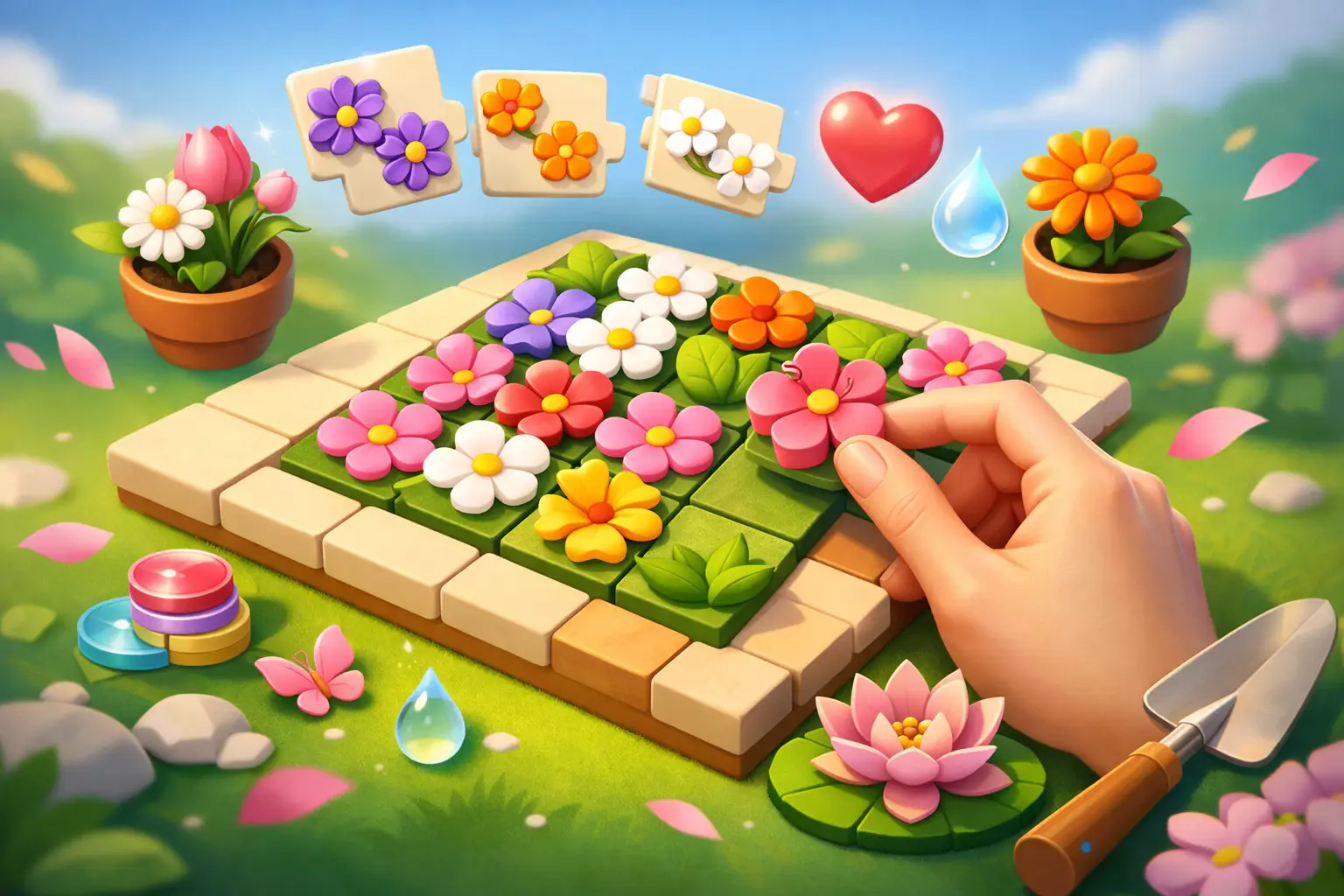
Some mobile games ask for too much too fast. A great flower puzzle game does the opposite. You open it, make one clean swap, watch petals burst across the board, and instantly feel that little spark of progress that makes you want one more level.
That feeling is not an accident. The best games in this category blend cozy visuals with sharp puzzle design, so every move feels easy to understand but still worth thinking about. For players who want relaxing entertainment with real momentum, that balance is exactly the point.
What makes a flower puzzle game stand out
At a glance, the formula sounds simple. Match colors, clear tiles, finish the goal. But not every puzzle game earns repeat play, and not every floral theme adds anything beyond decoration. The games people keep coming back to usually get three things right at the same time.
First, the board needs to be readable. If pieces are too busy or effects are too loud, the game starts to feel messy instead of satisfying. Flower-themed pieces work especially well when each bloom has a clear shape and color identity. You should be able to scan the board in a second, spot a possible combo, and act on it without friction.
Second, the level design has to create variety without becoming punishing. One level might ask you to collect tulips, another might focus on clearing grass, opening crates, or spreading growth across the board. That shift matters. It keeps the experience fresh while still staying friendly to players who want quick sessions on a phone or tablet.
Third, progress needs to feel visible. Winning a level is good. Winning a level and earning stars, rewards, decorations, event points, or leaderboard movement is much better. That layered sense of advancement turns a simple match into a hobby you actually want to revisit tomorrow.
The appeal goes beyond pretty visuals
Flowers are an easy theme to like, but the strongest flower puzzle game uses that visual style to improve the play experience, not just decorate it. Soft gardens, colorful buds, and blooming effects create a calmer rhythm than harsher puzzle themes. That makes each session feel inviting, even when the challenge starts to climb.
There is also a built-in emotional payoff. When a board clears in a burst of color, it feels more alive than clearing generic gems or blocks. Bloom animations, garden backgrounds, and seasonal details add warmth to the moment. It is a small design choice, but it changes how success lands.
That said, theme alone cannot carry weak mechanics. If the swaps feel sluggish or the goals feel repetitive, players notice quickly. The sweet spot is a game that delivers visual comfort and strategic clarity together. You want charm, but you also want levels that reward smart play.
Why match-3 still works so well on mobile
The match-3 format remains strong because it respects the way people actually play on phones. Sessions can be short. Controls are simple. The challenge is easy to read in a glance. Yet there is still room for planning, especially once blockers, limited moves, and combo pieces enter the board.
A flower puzzle game benefits from that structure because it keeps the entry point light. New players can understand the basics within seconds. More experienced players can start optimizing immediately, looking for bigger chains, better booster timing, and ways to complete side goals without wasting moves.
That range matters. Casual players want low friction. More invested players want mastery. A smart mobile puzzle game can serve both groups by making the first move simple and the later decisions more interesting.
The real hook is steady progress
Most players do not stay for visuals alone. They stay because the game keeps giving them something to build toward. That might be a new garden area, a limited-time event track, a collection set, a team challenge, or a stash of boosters saved for a tough world.
This is where the genre gets much stronger than people sometimes expect. A well-built flower puzzle game is not just a line of disconnected levels. It becomes a sequence of goals layered on top of each other. Finish a stage, earn rewards, unlock something decorative, advance in an event, and come back later for daily bonuses. Every session gives you more than one reason to play.
That design works especially well for people who like relaxing games but still want momentum. You are not grinding through complexity for its own sake. You are making visible progress in a world that keeps opening up.
Strategy matters more than people think
Cozy does not mean mindless. Once a game introduces tighter move counts, multi-step objectives, and special tiles, small decisions start to matter a lot.
The strongest move is not always the most obvious one. Sometimes it is better to set up a power piece than to grab an immediate three-match. Sometimes clearing the bottom of the board creates better cascades. Sometimes holding a booster for one turn lets you hit two objectives at once instead of one.
That is part of the lasting appeal. A flower puzzle game can feel gentle on the surface while still offering satisfying moments of problem-solving. You are not memorizing a complicated ruleset. You are reading the board, weighing trade-offs, and looking for the play that creates the most value.
For players who enjoy improving over time, that curve is rewarding. You feel yourself getting sharper. Levels that looked cluttered at first start to reveal patterns. You stop reacting to the board and start controlling it.
Rewards and events keep the experience lively
One reason modern mobile puzzle games hold attention longer is that they rarely stay static. Daily rewards give you a reason to check in. Limited-time events add urgency. Collections and seasonal content make the game world feel active instead of finished.
These systems work best when they support the core puzzle loop instead of distracting from it. If every reward helps you play more, play smarter, or personalize your progress, the experience feels generous. If too many systems pile up without clear value, it can feel noisy.
The difference comes down to pacing. Strong games know when to celebrate you, when to challenge you, and when to hand you the next reward. That rhythm creates a satisfying loop of effort and payoff. Every win feels like it matters, even if you only have a few minutes to play.
Social features can make a solo game better
Puzzle games are often personal, but that does not mean they have to feel isolated. Teams, co-op events, leaderboards, and shared goals give players a light social layer without adding pressure.
For many people, that is the ideal setup. You still play at your own pace, but your progress can contribute to something bigger. A team event turns one more level into one more point for the group. A leaderboard adds a little spark of competition. Sending and receiving lives keeps the experience friendly and active.
When done well, these features extend the life of a flower puzzle game. They make the world feel populated. They also create better comeback energy. Missing a day feels less like falling behind and more like returning to a garden that kept growing while you were away.
What players should look for before downloading
If you are choosing a new flower puzzle game, it helps to look past screenshots. Bright art is nice, but long-term fun comes from content depth and level quality.
A strong game should offer plenty of handcrafted levels, not just recycled board patterns with different colors. It should introduce new mechanics at a steady pace. It should reward regular play without making every session feel like work. And it should give you enough goals outside the puzzle board to keep progress exciting.
That is why games like Garden Match Puzzles appeal to both casual players and people who stick with match-3 for the long run. The best experience is not just about matching flowers. It is about building momentum across levels, rewards, events, and your own personal style of play.
The next time a puzzle game grabs you with one satisfying swap, pay attention to what happens after that. If the levels stay clever, the rewards keep flowing, and the world gives you something worth growing, you have found more than a quick distraction. You have found a game that knows how to make every bloom count.