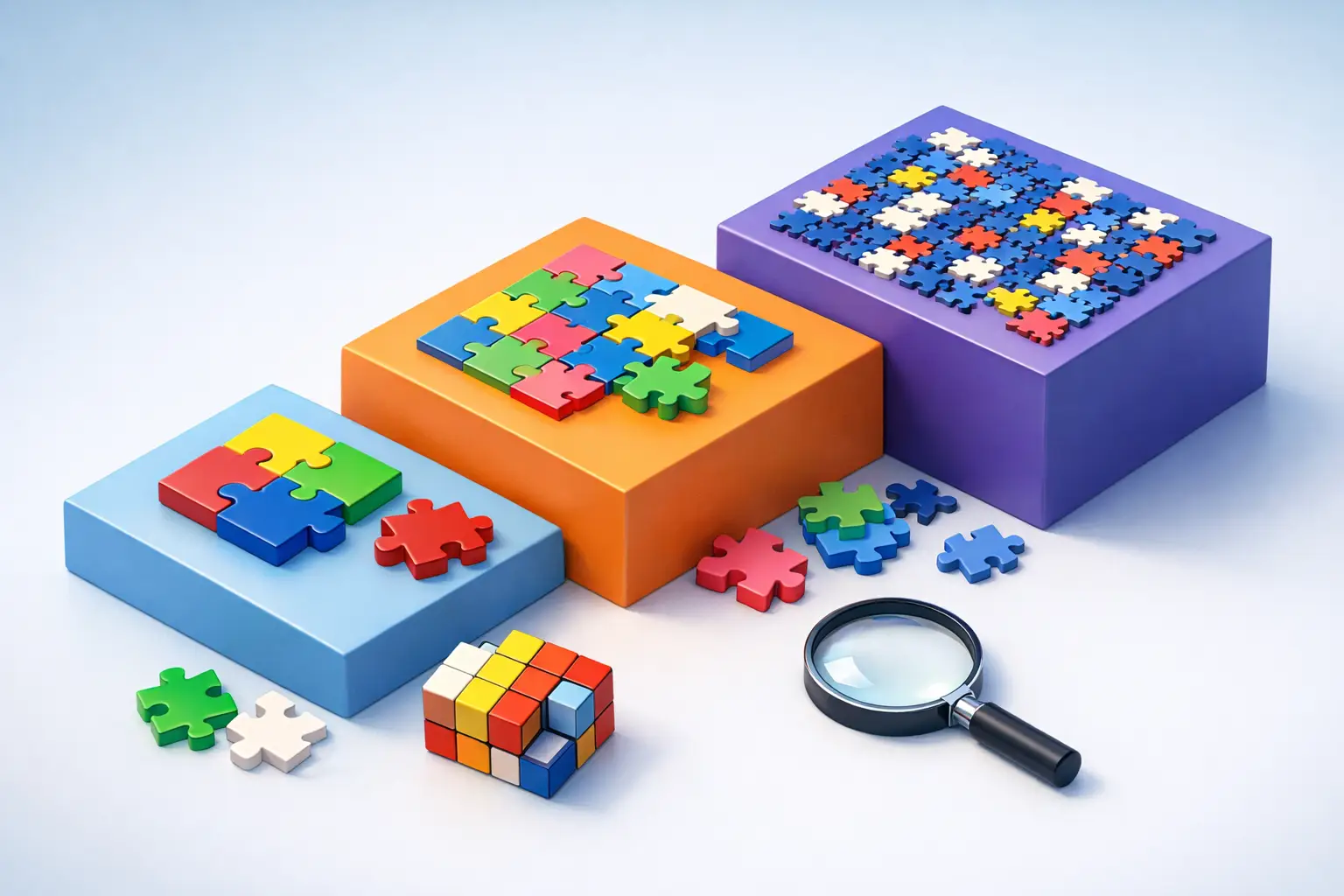
A good puzzle difficulty comparison starts with a simple truth: hard does not always mean better. The right level of challenge is the one that gives your brain a pleasant place to land after work, between errands, or before bed. Some players want a quick, satisfying clear. Others enjoy pausing over a board, spotting a chain reaction, and saving the right booster for exactly the right moment.
Match-3 games can offer both. The difference comes down to how a level asks you to think, how much room it gives you to recover, and whether each win feels earned rather than exhausting. Here is how to recognize the kinds of difficulty that suit your play style.
Puzzle Difficulty Comparison: More Than Easy or Hard
A level's challenge is not one straight line from simple to difficult. Two boards can have the same number of moves and feel completely different. One may be easy to understand but require careful planning. Another may look busy at first, then open up beautifully after a few smart swaps.
For most players, difficulty comes from four connected elements: the clarity of the goal, the shape of the board, the number of moves available, and the obstacles standing between you and the finish. When those elements work together, a challenging level feels like a small problem worth solving. When they do not, it can feel like the board is asking too much without showing why.
Thoughtful level design gives you information to work with. You can see what needs attention, notice which area is blocking your progress, and make a meaningful choice about your next move. That does not guarantee a first-try win, but it makes every attempt useful.
The Relaxed Level: Clear Goals and Visible Progress
Relaxed levels are the comfort food of match-3 play. Their goals are easy to read, the board has space to breathe, and a few ordinary matches can create enough movement to get things rolling. You may need to collect colors, clear tiles, or guide pieces toward an exit, but the path forward is usually visible.
These are ideal for a five-minute break. They reward instinct, let special pieces appear naturally, and provide frequent little moments of progress. A single swap can clear a corner, open a blocked area, and set up the next match all at once. Every swap feels amazing because the board responds quickly.
Relaxed does not mean forgettable. A well-made easy level teaches a new idea, refreshes a familiar mechanic, or gives you a satisfying chance to use combinations you already understand. It is the kind of board that helps you build momentum through a new world, earn a few garden rewards, and leave the game feeling lighter than when you opened it.
The Strategic Level: A Few Moves That Matter
Strategic levels sit in the middle of a puzzle difficulty comparison. They are still welcoming, but they ask you to look beyond the first available match. You might need to clear obstacles in a certain order, protect space near the bottom of the board, or decide whether a promising combination is better now or one move later.
The key difference is that the challenge comes from decisions, not confusion. You can often see several possible moves, and each one has a trade-off. Clearing a blocker on the left may open the board, while making a special piece on the right may help you reach a collection goal. Neither choice is automatically wrong. The fun is in reading the board and choosing what matters most.
These levels are especially rewarding for players who enjoy a calm kind of focus. They work well in a 10- to 20-minute session because you can settle into a rhythm: scan the board, make a purposeful swap, watch the cascade, then reassess. A win feels good because it came from attention, not speed.
What Makes Strategy Feel Fair
A strategic board should offer a way back when your first plan changes. Cascades are part of match-3 games, and sometimes they create an unexpected opening or use up a helpful setup. Fair difficulty leaves enough options that you can adapt.
Look for levels where the goals connect to the board layout. If an obstacle is in the way, clearing it should create useful space. If an item must travel downward, the board should give you chances to work underneath it. The most satisfying puzzles make the solution emerge piece by piece, like a garden bed filling out as new blooms appear.
The Demanding Level: Layered Goals and Tight Choices
Demanding levels are designed for the moments when you want a little more from your puzzle time. They may combine several objectives, place obstacles in awkward corners, or give you a move count that requires a stronger plan. These are the boards that make a victory feel like a real harvest.
The best demanding levels still begin with a readable question: What is stopping me from making progress? Often, the answer is not the goal itself. A blocked center might prevent matches from connecting. A narrow lane may keep key pieces from dropping. A hard-to-reach tile may need a special-piece combination rather than several small matches.
Before making your first move, take a few seconds to identify the board's bottleneck. Then prioritize moves that create space or reach multiple goals at once. A match that clears one target can be fine; a move that clears a target, opens a lane, and builds a special piece is usually better.
Demanding does not have to mean draining. A good tough level gives you a reason to try a different approach. Maybe the obvious top-of-board match is less useful than a lower move that changes the entire layout. Maybe a booster is worth using because it turns a near-win into a clean finish. The point is not to play perfectly. It is to notice more possibilities as you go.
How Board Shape Changes the Challenge
Board shape has a bigger effect on difficulty than many players realize. Open boards tend to produce more natural cascades and more chances to make combinations. Split boards, narrow columns, and isolated corners make every move more specific because a match in one area may do little for another.
A board with a wide center and restricted edges often asks you to work outward. A board with blockers in the middle asks you to create an opening before you worry about collecting every last color. If items need to reach the bottom, low matches matter more than high ones because they create room for the board to refill.
This is why two levels with identical objectives can feel so different. The goal is only half the puzzle. The board determines how efficiently you can reach it.
Special Pieces Change the Math
Special pieces are not just rewards for making larger matches. They are tools for changing a board that ordinary swaps cannot reach efficiently. A line-clearing piece can solve a narrow lane. An area-clearing piece can break through clustered obstacles. Combining special pieces can transform a stalled board into a fresh set of opportunities.
On relaxed levels, use them when it feels fun. On strategic and demanding levels, consider where they will have the largest impact. Saving a special piece for a dense obstacle section is often wiser than using it the moment it appears. Still, there is no universal rule. If using it now opens the board and creates new matches, that can be the stronger play.
Choosing the Right Challenge for Your Session
Your preferred difficulty can change from day to day. After a long afternoon, a familiar level with quick progress may be exactly right. On a quiet weekend morning, a layered board may be more satisfying because you have time to experiment.
Choose relaxed levels when you want a dependable reset and visible progress. Choose strategic levels when you want a few meaningful decisions without a long commitment. Choose demanding levels when you are in the mood to work through a puzzle, test a booster plan, and enjoy the extra satisfaction of a carefully earned clear.
Garden Match Puzzles is built around that variety. Across hand-crafted levels and themed worlds, the goal is depth without making every session feel like an assignment. You can play anytime, return to a tricky board with fresh eyes, and keep growing your garden at a pace that fits your life.
A Better Way to Judge Difficulty
Instead of asking whether a level is easy or hard, ask whether it gives you a useful next move. A good puzzle may surprise you, ask for patience, and take more than one attempt. But it should also teach you something about the board each time you play.
That is the kind of challenge worth keeping in your daily routine: a small space to think clearly, make one good choice, and watch it lead to the next bloom.