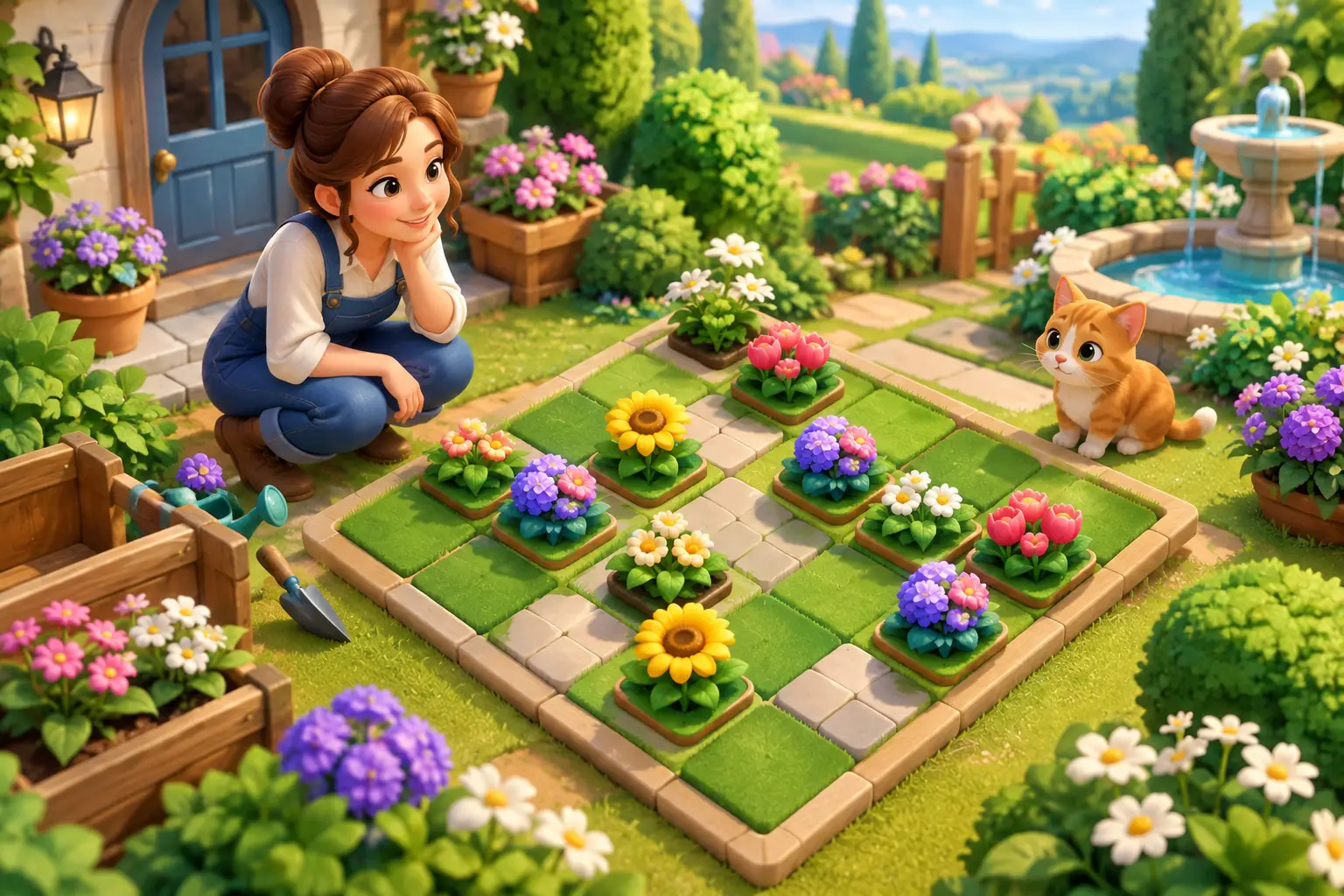
A good evening game has a particular job: give your mind something pleasant to focus on, then let you set it down feeling a little more settled than before. This free puzzle game review looks at the details that make that happen - satisfying match-3 boards, clear goals, a garden that gradually takes shape, and progress that fits into real life.
Garden Match Puzzles is built for players who want more than a quick distraction but less than another obligation. A five-minute session can clear a tricky level or add a new bloom to your garden. A longer session gives you room to plan a few moves ahead, build a useful booster collection, and work toward a seasonal reward. The pace is yours.
What a Free Puzzle Game Should Deliver
“Free” should mean you can settle in and play, not that every enjoyable moment comes with a condition attached. The strongest free puzzle games make their core loop generous: you understand the objective, make smart swaps, learn from a near miss, and try a new approach without losing your evening to a wall of friction.
That is especially valuable in match-3 games, where the rules are simple but the decisions can be surprisingly rich. Matching three pieces clears space. Matching four or more creates special pieces with more power. Combining those pieces at the right moment can transform a crowded board. The pleasure comes from seeing a small plan pay off, whether you are removing a stubborn blocker or setting off a chain reaction that clears half the board.
The best levels do not ask you to memorize complicated systems. They introduce one fresh idea, give you a chance to understand it, then layer it with familiar elements. You stay engaged because the puzzle changes, not because the controls become harder to read.
Free Puzzle Game Review: How Each Level Feels
The first thing to notice is the rhythm. Levels are designed around specific goals, such as collecting certain tiles, clearing garden paths, or guiding an object through the board. That focus keeps each puzzle readable. You know what you are trying to accomplish, even when the board asks for a little patience.
There is real satisfaction in a well-placed swap. A move near the bottom of the board may open space above it. A special piece saved for two extra turns may be more valuable than one used immediately. When a level is difficult, the answer is often not faster tapping. It is pausing long enough to look for the move that changes the shape of the board.
Strategy Without a Study Session
A relaxing game still benefits from thoughtful choices. Start by checking the goal before making an obvious match. If a level asks you to clear a certain kind of tile, work near those tiles whenever possible. If blockers are restricting the board, opening space is usually more useful than collecting easy matches at the edges.
Boosters add another layer without taking over the experience. They are most satisfying when they support a plan you already understand: clearing one last difficult corner, creating a needed opening, or extending a powerful combination. Used this way, they feel like useful gardening tools rather than a substitute for the puzzle itself.
Not every level will fall on the first attempt, and that is part of the appeal. A close result tells you something concrete. Perhaps a blocker needs attention earlier, or perhaps holding a special piece until the board is more open will create a better result. The game rewards observation and persistence without requiring perfect play.
A Thousand Hand-Crafted Reasons to Return
Content volume matters when a game becomes part of your routine. With 1,000 hand-crafted levels spread across 45 themed worlds, there is space for the experience to grow gradually. New board layouts, goals, and obstacles keep the familiar swap-and-match foundation from becoming repetitive.
That scale also makes short sessions feel worthwhile. You do not need to reserve an hour to make progress. Clear two levels while your coffee brews, revisit a challenge during a commute break, or play a few more before bed. A hobby can be consistent without demanding your full attention.
The Garden Gives Progress a Personal Shape
Puzzle wins are pleasant on their own, but a garden gives them a place to land. Instead of progress living only on a level map, it becomes visible in the spaces you decorate and the details you choose. A new path, fountain, flowerbed, or tucked-away seating area can make a completed chapter feel tangible.
This is where personal taste matters more than speed. Some players will enjoy arranging every corner as soon as they earn a new decoration. Others will save options and make several choices at once. Neither approach is wrong. The garden is a record of the time you have spent with the game, and it should look like yours.
Collections, daily rewards, and seasonal events add gentle reasons to check in. They work best as small rituals rather than chores: a reward to collect with your morning tea, a new decorative goal after work, or a themed board to enjoy when you have a few quiet minutes. Each completed level can add a little color to the larger picture.
Progress That Respects Your Time
The most welcome design choice is simple: you can always play. There is no need to wait for permission to take another turn. That matters for adults whose downtime arrives in uneven pockets - ten minutes before a meeting, twenty minutes after dinner, or a rare slow Saturday morning.
Optional purchases can enhance progress, provide helpful boosters, and support cosmetic advancement, but they never gate your ability to continue playing. For some players, that will mean occasionally choosing an extra tool for a favorite challenge. For others, it will mean enjoying the full core experience at their own pace. Both are valid ways to play.
The premium reward track follows the same principle. It offers added rewards for people who want them, while the central pleasure remains available to everyone: smart moves, bright boards, and a garden that keeps growing one completed task at a time.
A Social Layer With Room to Breathe
Co-op play and leaderboards bring a little shared energy to a mostly personal hobby. You can celebrate a strong week, contribute to a group goal, or see how your progress compares without turning every session into a competition. For many players, that is the right amount of connection - friendly, visible, and easy to step away from.
If you prefer playing solo, the game still feels complete. If you enjoy having a few fellow players nearby, co-op features provide a reason to share the harvest. The choice is not between being intensely social and being isolated. It is simply another way to shape your routine.
Who Will Enjoy This Most?
This game is a strong fit for people who like match-3 puzzles as a daily wind-down, particularly if decorating and collecting make each completed level feel more meaningful. It also has enough level variety for experienced players who enjoy spotting combinations, managing board space, and using boosters with intention.
The trade-off is that players seeking fast, noisy action may find the measured garden pace too calm. This is not built around constant spectacle. Its strengths are consistency, clarity, and the quiet pleasure of seeing steady effort add up. You might clear 47 levels over a week, add 12 new blooms to your garden, and have a better sense of what to try when the next hard board appears.
For a free puzzle game, that is a thoughtful promise: every swap can feel rewarding, every session can move something forward, and your garden can keep growing whenever you have a few minutes to tend it.