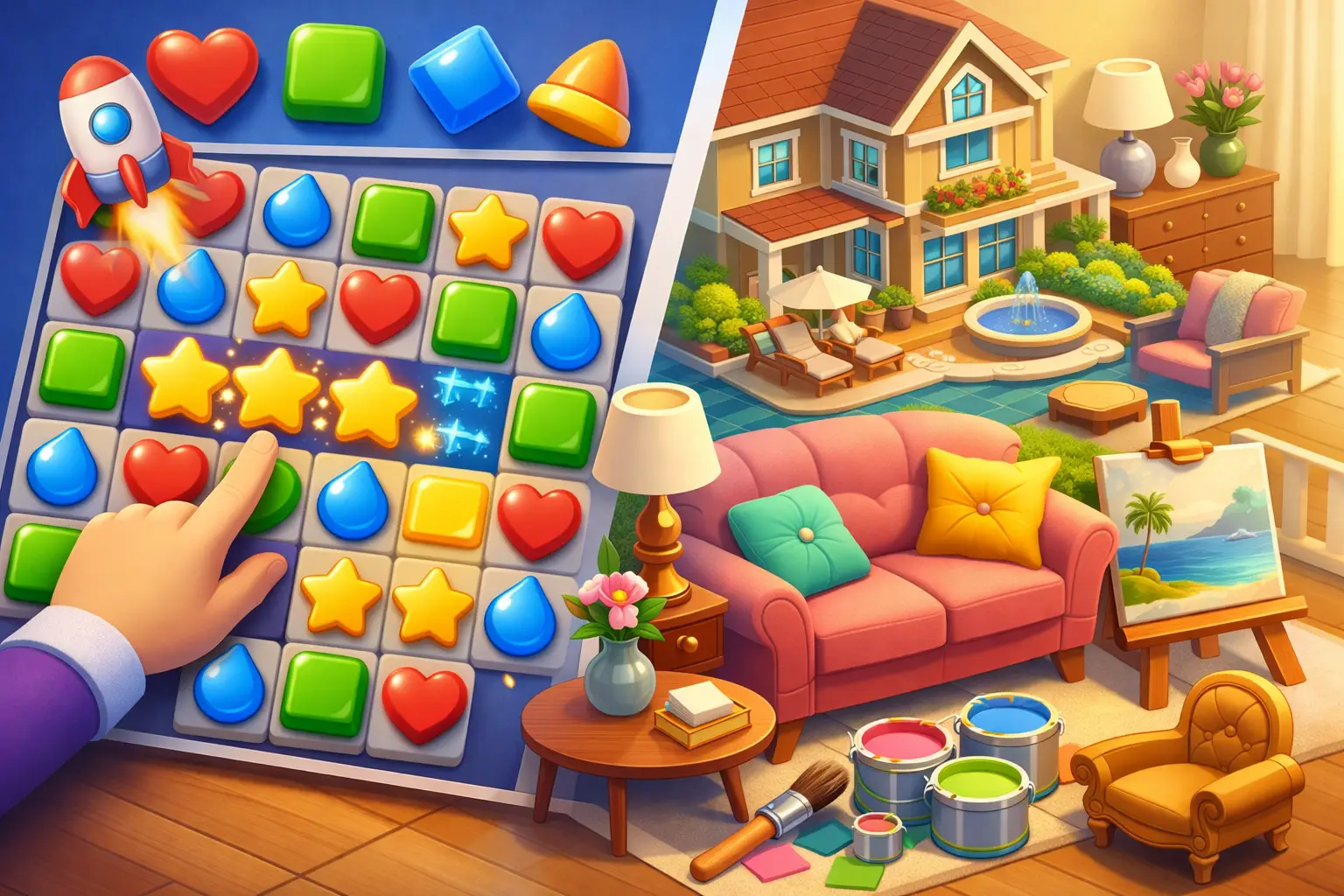
A good puzzle game gives you that small click of satisfaction - one smart move, one cleared board, one more level before bed. But the best puzzle games with decoration features add something extra: a place to put your progress. A room warms up, a garden starts to bloom, or a quiet corner takes shape piece by piece. That sense of visible progress is what keeps the genre feeling fresh long after the first hundred levels.
For many players, decoration is not just a bonus layered on top of puzzle play. It is the reason each session feels personal. You are not only solving boards. You are building a space that reflects your taste, at your pace, in five-minute pockets that fit real life. That matters if your ideal game is something you can pick up on the couch, during a commute, or while winding down at the end of the day.
What makes the best puzzle games with decoration features work
The strongest games in this category do two jobs well. First, the puzzle loop has to feel good on its own. Swaps should be readable, goals should be clear, and wins should come from smart choices rather than noise on the screen. Second, decoration needs to feel connected to play instead of pasted on afterward.
When that connection works, every level has a purpose beyond a score. Clear a few stages, and you earn enough to place a bench, repaint a room, or unlock a new set of flowers. The board gives you momentum. The decorating gives you attachment.
That balance is surprisingly delicate. If the decorating is too shallow, it starts to feel like you are just tapping through chores between levels. If the puzzle design is weak, no amount of wallpaper choices can carry the experience. The best games respect both sides of the equation.
10 best puzzle games with decoration features worth your time
1. Garden Match Puzzles
If you want a match-3 game that treats decorating as a real reward rather than a side note, Garden Match Puzzles earns a spot near the top. Its core play is instantly readable, but there is enough depth in the level design to keep later worlds interesting. You are not wrestling with clutter or trying to decode the board. Every swap feels deliberate.
The decoration side lands well because it grows over time. Gardens open up in themed spaces, and your progress turns into visible blooms, paths, and details that make the world feel tended rather than merely unlocked. It also helps that play is always available, which makes it easy to keep the rhythm going whenever you have ten quiet minutes.
2. Story-led room renovation puzzlers
This is the format many players recognize first: solve a puzzle, earn stars or tokens, and spend them on furniture, paint, or room upgrades. The appeal is simple. A drab room becomes welcoming one choice at a time, and each chapter gives you a new space to shape.
These games work best when the writing stays light and the room updates feel substantial. If every task only changes a tiny object, the decorating can start to feel slow. But when a single win visibly transforms the room, the reward loop stays satisfying.
3. Garden restoration games
Garden themes and puzzle mechanics are a natural fit. There is an immediate sense of growth in restoring hedges, fountains, flowerbeds, and hidden corners. Even small changes register clearly, which makes short play sessions feel productive.
The best versions keep the setting calm and readable. You are not managing a hundred systems. You are steadily bringing a neglected outdoor space back into bloom, one puzzle at a time. For players who like cozy progression, this can be more relaxing than interior design.
4. Merge-and-decorate hybrids
Not every decorating puzzle game is pure match-3. Merge games often use the same reward psychology in a slightly different form. Instead of swapping tiles, you combine items to create tools, furniture, or decorative pieces that help restore a home or garden.
These can be especially appealing if you enjoy slower, more methodical play. The trade-off is that merging usually feels less crisp than a strong match-3 board. Some players love the steady crafting rhythm. Others miss the sharper moment-to-moment decisions of a swap puzzle.
5. Hidden-object decorating games
If you like puzzle sessions that feel quieter and more observational, hidden-object games with decoration systems are still a strong option. Search scenes, find listed items, and use your progress to restore or personalize a location.
The decorating is often simpler here, but the atmosphere can be excellent. These games are less about chain reactions and more about settling into a scene. They fit well for players who want a slower wind-down in the evening.
6. Match games with broad world-building
Some decoration-focused puzzle games go beyond a single room or garden and let you restore an entire estate, neighborhood, or sequence of themed spaces. That wider scope creates a stronger sense of journey. You are not just fixing one area. You are moving through seasons, styles, and new visual goals.
This format works best when the game keeps its goals clear. Bigger worlds can feel generous, but they can also become diffuse if too many systems compete for attention. A clean map and steady pacing make all the difference.
7. Seasonal decorating puzzlers
A game that updates its spaces around spring, summer, harvest season, or winter can be especially satisfying if you enjoy visual variety. Seasonal themes make familiar mechanics feel fresh without forcing you to relearn the game.
The best examples use seasons to inspire decoration choices and side goals, not to overwhelm the player. A few well-placed event spaces or themed collections can add charm. Too much event layering, and the game starts to feel busy instead of cozy.
8. Narrative-first renovation games
Some players want stronger story beats between puzzles. In these games, decorating is tied closely to characters, backstory, and chapter progression. A room makeover becomes part of a larger emotional arc.
That can be very effective if you like a sense of narrative momentum. The trade-off is pace. More dialogue and cutscenes can slow the quick-session appeal that many mobile puzzle players value. Whether that feels rich or distracting depends on why you play.
9. Collection-based decorating games
Another satisfying branch of the genre ties decoration to collectible sets. You complete puzzle goals, gather themed items, and use them to fill out spaces with plants, ornaments, or furnishings. This creates a nice sense of long-term progress because your work adds up in more than one way.
Collection systems feel best when they are easy to understand and rewarding in small doses. If every decorative item takes too long to earn, the joy fades. But when new pieces arrive at a steady pace, your space keeps evolving naturally.
10. Co-op friendly puzzle decorators
For many adults, light social play is a plus as long as it stays low pressure. Puzzle games with decoration features can benefit from team events, shared goals, or leaderboards that celebrate progress without turning every session into a contest.
This style works well because decorating is inherently personal, while cooperative play adds a bit of community around it. You still get your own space to build, but there is also a pleasant sense that other people are tending their own corners alongside you.
How to choose the best puzzle games with decoration features for you
Start with the puzzle loop, not the decorating catalog. If the core play feels muddy, repetitive, or overly noisy, the decorating will not carry it for long. A game you return to for months usually has a board that feels satisfying even before you spend your first reward.
Then look at how decoration is delivered. Some players want frequent, smaller upgrades that make every session feel productive. Others prefer bigger visual transformations after a longer stretch of play. Neither is better. It depends on whether you find motivation in steady sprouts or in larger reveals.
Session length matters too. If you mostly play in ten-minute windows, choose a game that gets you into a level quickly and lets you make visible progress without long interruptions. If you enjoy lingering with a story at night, a more narrative-heavy renovation game may suit you better.
Finally, pay attention to tone. The best casual puzzle games for adults feel welcoming without talking down to you. They offer clarity, color, and momentum, but they also leave room to breathe. That is often what turns a pleasant app into a lasting habit.
Why decoration keeps puzzle games feeling fresh
Puzzle mechanics are great at delivering short bursts of satisfaction. Decoration is what turns those bursts into something cumulative. You can look at a restored room or a blooming garden and remember that you cleared the levels that made it possible. Progress becomes visible, not abstract.
That is why this corner of mobile gaming has such staying power. It blends strategy with self-expression, structure with comfort, and routine with a little creativity. When the balance is right, even a quick evening session leaves something behind - a new path laid, a fresh set of flowers planted, a space that feels a bit more like yours.
If you are choosing your next daily game, look for one where the puzzles feel crisp and the decorating feels earned. The sweet spot is simple: play that respects your time, and a space that keeps blooming because you came back to it.