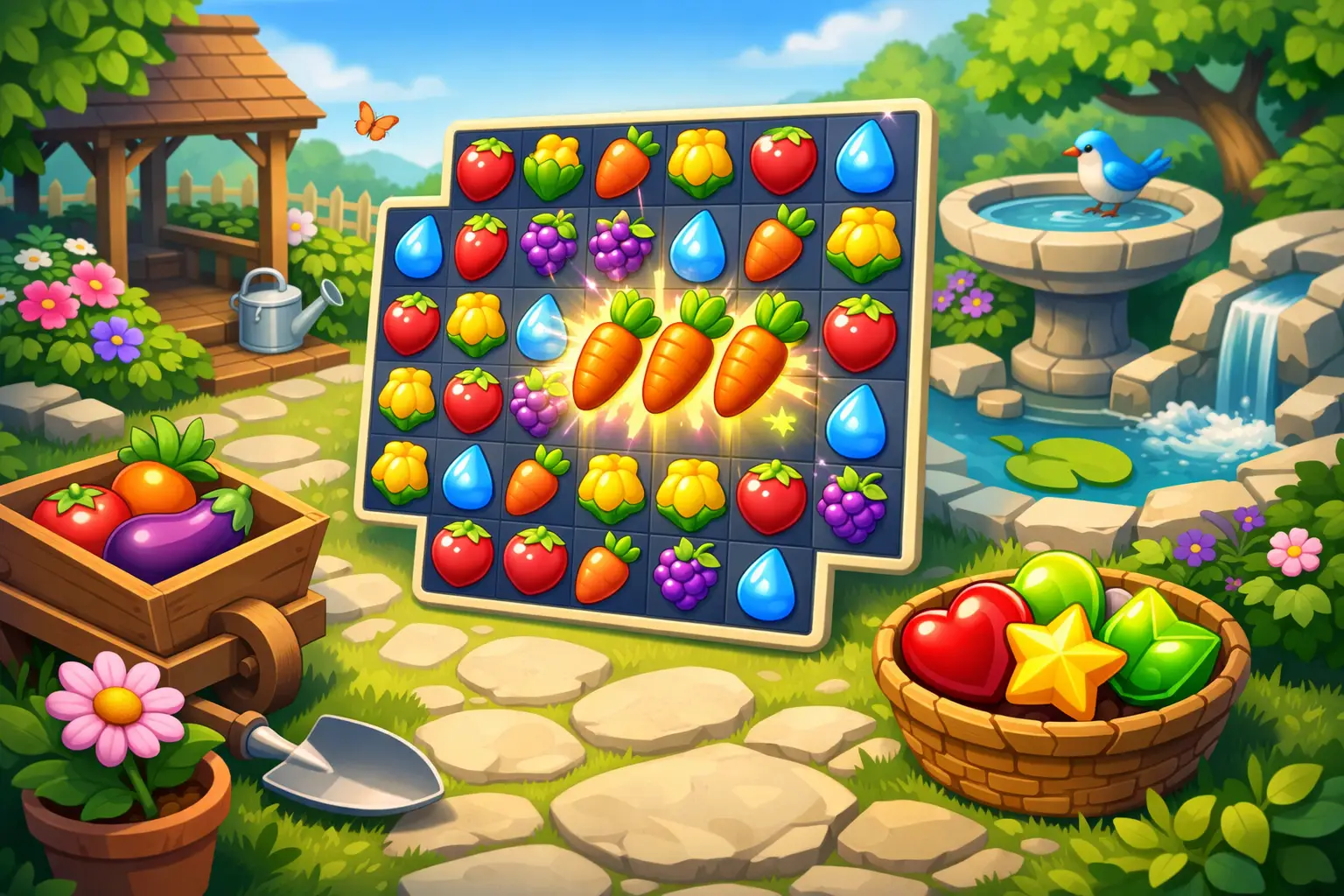
A good indie puzzle game review should answer a simple question: will this game make a 10-minute break feel better? Garden Match Puzzles makes a strong case. Its familiar swap-and-match board is easy to read, but the levels ask for enough planning that a satisfying clear feels earned rather than automatic. It is designed for adults who want a pleasant daily ritual with real progress waiting on the other side of each session.
What This Indie Puzzle Game Review Looks For
A match-3 game has a lot to balance. The first few moves need to feel immediate, the challenge needs to grow without becoming exhausting, and the rewards need to give every cleared level a purpose. The best puzzle games also understand that a player may be checking in between errands, on a commute, or while winding down before bed.
This review looks at four things: level design, progression, garden customization, and the way the game treats a player’s time. Those details matter more than flashy effects because they determine whether a game still feels inviting after the first few evenings.
The Core Puzzles Feel Clear, Then Clever
Every level starts with a board that communicates its goal quickly. Match colors, clear obstacles, gather pieces, and make room for the combinations that can change the board in one move. That clarity is a real strength. You do not need a long tutorial before making a useful decision.
The more interesting moments come when the board asks you to look beyond the nearest match. A simple three-piece swap may keep things moving, but a four- or five-piece match can create a booster with much more reach. Setting two boosters beside each other can turn a crowded board into an open field of possibilities. Those choices give experienced match-3 players room to think while keeping the basics approachable for anyone returning after a long day.
There is a welcome rhythm to the difficulty curve. Early levels let you learn how obstacles and boosters behave. Later stages layer goals together, so you may need to clear a path before collecting the pieces that matter most. The challenge comes from reading the board and choosing an order of operations, not from burying the player in complicated rules.
That does mean the game favors thoughtful, measured play over rapid-fire excitement. If you want every session to feel intense, its cozy pace may not be your preferred style. For players looking for a puzzle that rewards a careful pause before the next swap, that pace is exactly the point.
Boosters Add Strategy Without Taking Over
Boosters work best when they feel like tools, not a substitute for attention. Here, they support the puzzle-solving loop. A well-placed rocket can open a narrow lane. A larger combination can reach scattered objectives. Saved boosters can be particularly useful on boards where the final few pieces are tucked behind several layers of obstacles.
The key is that using a booster is a choice, not a requirement for enjoying ordinary levels. You can build a useful supply through play, daily rewards, events, and smart level clears. Optional purchases can enhance progress, but they never gate it. That makes a difficult board feel like a problem to solve in your own time rather than a wall you are expected to push through.
A Garden That Shows What You Have Accomplished
The puzzle board provides the moment-to-moment focus, while the garden gives progress a physical shape. Clearing levels earns resources that help restore and decorate themed spaces across the game’s worlds. A new path, flower bed, bench, or decorative detail is a small, visible record of time well spent.
This is where the game’s 45 themed worlds do more than provide a background. Each area gives the next stretch of levels a sense of place. Instead of clearing puzzles into an abstract counter, you are tending a garden that gradually becomes more personal and more complete. After a week of play, it is easy to see that you cleared 47 levels and added 12 new blooms. That kind of concrete progress is especially satisfying in short sessions.
Customization also gives the game a gentler kind of choice. You are not asked to make a perfect decision under pressure. You can settle into the designs you like, then return later to keep shaping the space. For players who enjoy collecting and decorating as much as solving, the garden is not a side feature. It is part of the reward.
Plenty to Do, Without a Crowded Feel
With 1,000 hand-crafted levels, there is enough puzzle content to support a steady habit. The game also adds daily rewards, collections, seasonal events, leaderboards, and cooperative multiplayer. The important part is how these features fit around the main game. They offer different reasons to return without obscuring the simple pleasure of clearing a board.
Daily rewards are useful for a quick check-in, while collections give individual sessions a longer arc. Seasonal events add a change of scenery and fresh goals. Players who enjoy a little friendly connection can join a co-op group, share in collective progress, and celebrate a strong week together.
The social side stays light. A leaderboard can be motivating if you enjoy seeing your progress among other players, but it does not need to define your experience. You can focus on your own garden, play at your own pace, and still have a full game to enjoy. That flexibility suits a hobby that may fit into 5 minutes on one day and 20 minutes on the next.
Progress Respects Your Schedule
The most player-friendly detail is simple: you can play anytime. A level is there when you have a few spare minutes, and your progress waits when you do not. This matters for casual players because a game should fit around life, not ask life to fit around a game.
The free-to-play structure is built around optional ways to speed up or personalize your experience. Premium rewards and extra resources can be appealing if you want more of what you already enjoy, especially during a favorite season or while completing a decorative set. But the central experience remains available through regular play. You can keep learning the boards, gathering rewards, and growing your garden without treating a purchase as the price of participation.
That approach will appeal most to players who value consistency. There are games that make every session feel like a huge event. This one is more interested in the steady pleasure of a good move, a cleared level, and a garden that looks a little fuller than it did yesterday.
Who Will Enjoy Garden Match Puzzles?
Garden Match Puzzles is a particularly good fit for adults who want a relaxed puzzle habit with more substance than a handful of quick boards. The match-3 mechanics are easy to pick up, but the level design offers enough variety to keep experienced players engaged. Garden building, collections, and events give each cleared level a purpose beyond the score.
It is also well suited to people who prefer a game that leaves room for choice. You can make a few levels of progress before bed, plan a booster combination during a longer session, or spend time arranging a newly opened garden area. The experience meets you where you are.
The best puzzle games do not demand all your attention. They make the attention you choose to give feel worthwhile. A thoughtful swap can clear the way, a small reward can become a new bloom, and tomorrow’s garden can wait patiently until you are ready to return.