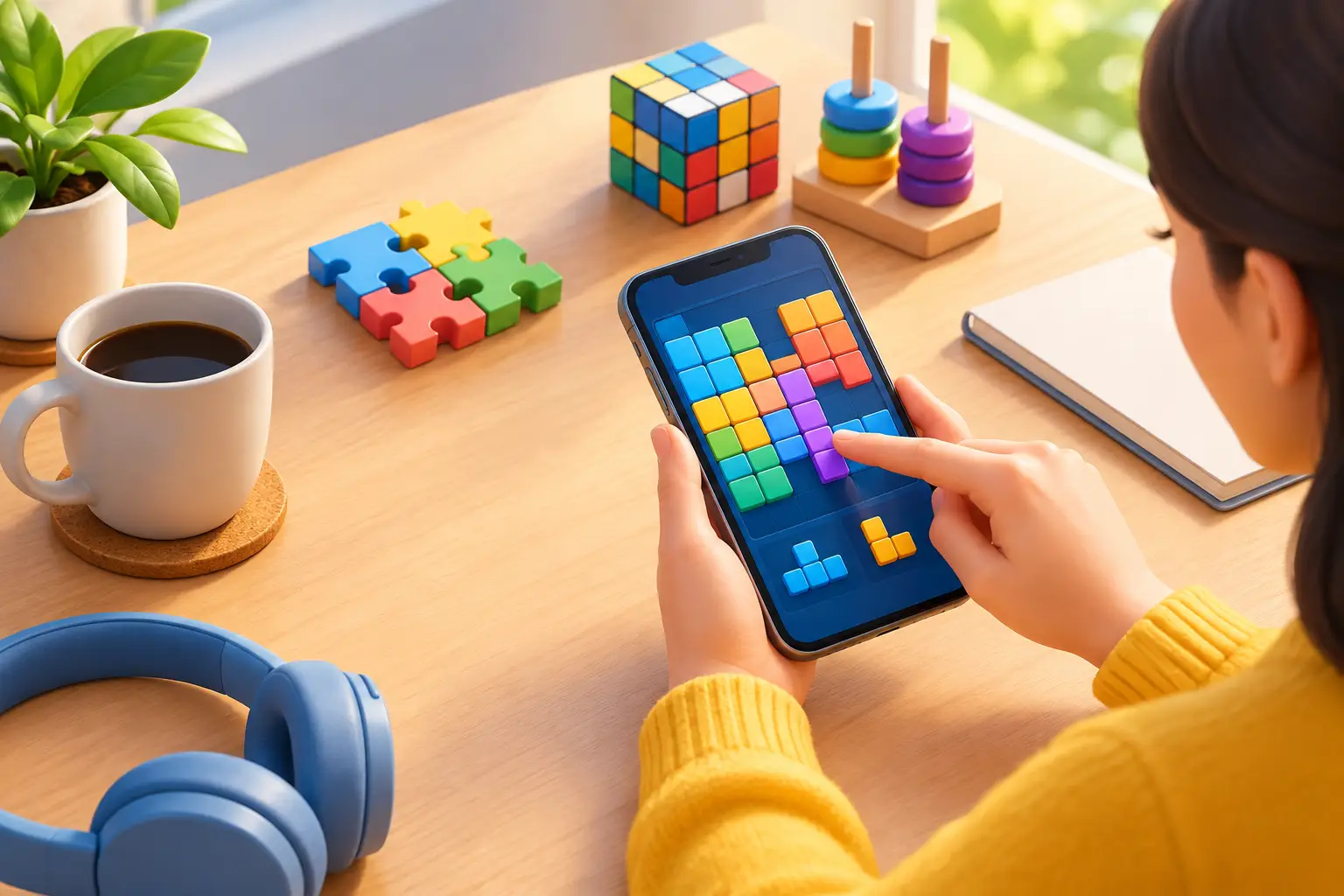
A good puzzle game does not need to ask for your whole evening. It needs to make ten quiet minutes feel well spent. The best puzzle games offer a clear little problem, a few satisfying decisions, and a visible result before life calls you back to the next thing.
That is why a thoughtful match-3 session can fit so naturally into a commute, a coffee break, or the stretch of time before bed. You are not studying a rulebook or trying to keep up with a crowded screen. You are looking for the move that brings the board into focus: three pieces line up, a booster clears a path, and the level changes shape in a way that feels earned.
Why puzzle games feel good in small doses
A great puzzle begins with an understandable goal. Clear the moss, collect the flowers, guide an item to the bottom of the board, or make room for a special piece. The basic action may be a simple swap, but the decisions build quickly. Which match opens the most space? Is this the right moment to use a booster? Can one move set up two useful effects at once?
That balance is what makes short sessions feel complete rather than disposable. You can finish one level with a clean solution, make a little progress on a tougher board, or collect a reward that supports your next attempt. There is a natural stopping point, but there is also a gentle invitation to return when you have another few minutes.
The strongest games give you more than points. They let progress take a shape you can see. A restored garden bed, a new decorative choice, a collection milestone, or a fresh area to explore makes your effort feel personal. Each cleared level becomes part of something warmer and more lasting than a score total.
The sweet spot: simple rules, real choices
Approachable does not mean shallow. In fact, the most relaxing games are often designed with considerable care behind the scenes. You should understand what to do almost immediately, while still finding new tactical choices many levels later.
Match-3 games create this feeling especially well. A single move can remove an obstacle, charge a special piece, and set up a chain reaction. Those moments are satisfying because they come from attention, not from complicated controls. You notice the opportunity, make the swap, and watch the board respond.
Look for levels with a purpose
Good level design gives each board its own character. One may ask you to clear a compact corner. Another may reward patience as you open the center of the board. A later level might ask you to plan around several objectives at once. The goal is not to make every level difficult. It is to make each one interesting.
Variety matters more than constant novelty. New obstacles and mechanics should add a fresh question to the familiar rhythm, not make the game feel like work. When a game introduces an idea clearly and then gives you room to practice it, your confidence grows along with your skill.
Save powerful tools for meaningful moments
Boosters are most satisfying when they help you make a choice, rather than make choices for you. Sometimes a well-placed tool turns a near-win into a completed level. Other times, holding it for a board with a particularly stubborn obstacle is the smarter move.
There is no single right approach. If you play to unwind, using a booster to keep the evening pleasant can be a perfectly good decision. If you enjoy solving a board with the fewest extras possible, save your tools and look for a better setup. A respectful game supports both styles.
How to make a puzzle-game session more satisfying
A few small habits can help you get more enjoyment from every session. Before making your first move, pause for a moment and scan the whole board. Notice where the obstacles are clustered, which objectives are hardest to reach, and whether a match near the bottom could create useful movement above it.
When possible, make moves that open space instead of only clearing the closest available match. An open board produces more options, more accidental cascades, and more chances to create special pieces. This is especially useful when the board has blocked corners or items that need to travel downward.
Try not to spend every special piece as soon as it appears. Combining two can be much more effective than using them separately, particularly when you need to clear a broad section of the board. Still, do not wait so long for a perfect combination that you miss a practical move. A useful clear now may create the board you need next.
Most importantly, let the session be the size it needs to be. One level is enough if it gives you the reset you wanted. Five levels may be right when you are settling into the couch with a little more time. The hobby should fit around your day, not ask your day to fit around it.
Progress that feels like your own garden
Puzzle games become more memorable when they pair problem-solving with a place that changes over time. Decorating is not just an extra menu. It gives your decisions a home. Choosing a bench, a path, a fountain, or a patch of blooms turns steady play into a garden with your own point of view.
That sense of craft is especially welcome after a busy day. A level might take a few minutes, but the garden it supports can grow across weeks. You can look back and see concrete change: another corner restored, a new world opened, twelve new blooms arranged just the way you like them.
At Garden Match Puzzles, that long-view feeling is built around hand-crafted levels and themed worlds, with garden-building alongside the boards. There is always another small area to tend, another collection to complete, or another clever challenge waiting when you are ready. You can play anytime, and purchases never gate progress.
A little connection, without the pressure
For many players, puzzle games are a personal pause. For others, a touch of community makes the routine brighter. A co-op group can offer the pleasant feeling of working alongside people who understand why clearing one tricky board feels good. Seasonal events can add a shared theme without asking you to rearrange your schedule.
The best social features remain optional and easygoing. A leaderboard can give you a goal if you enjoy seeing your progress climb, while daily rewards can mark the rhythm of a returning habit. Neither needs to turn a relaxing game into a race. The point is to add variety and small moments of recognition.
What to choose in a lasting puzzle game
If you are looking for a game to keep on your phone for months rather than days, consider the full experience around the core puzzle. Does the game have enough hand-crafted content to stay fresh? Do new worlds, events, and collections give your progress direction? Can you decorate or customize in a way that feels genuinely yours?
Also pay attention to how the game treats your time. Clear objectives, readable boards, and flexible session lengths are not minor details. They are the difference between a hobby that restores your attention and one that scatters it. A polished game should make it easy to come back after a day away and remember what you enjoyed.
The next time you have ten minutes to spare, choose a board with a small challenge and a little room to think. One smart swap can clear more than a path through the puzzle - it can leave your day feeling a bit more orderly, too.