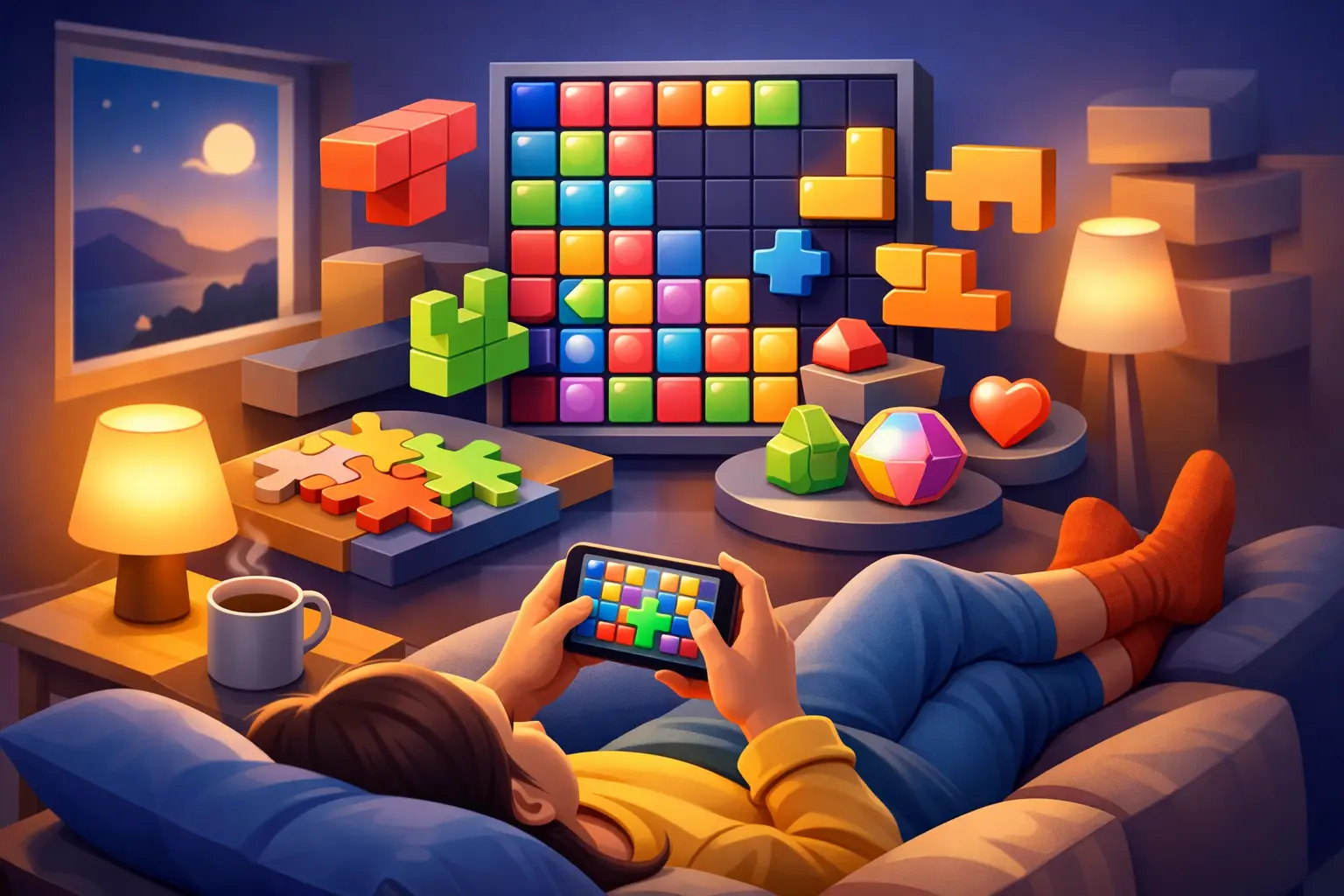
The day does not always end when work does. You might still be replaying a difficult conversation, sorting tomorrow's to-do list, or carrying the general hum of a busy house into the evening. Can puzzle games help unwind in that moment? For many adults, they can - not by making every stressor disappear, but by giving the mind one pleasant, manageable thing to focus on.
A good puzzle game asks for attention without asking for your whole evening. You notice a possible match, make a satisfying swap, clear a goal, and see the board open up. That small cycle can create a useful pause between the demands of the day and whatever comes next.
Why Puzzle Games Can Help You Unwind
Relaxation is not always about doing nothing. Sometimes a wandering mind needs a gentle place to land. Match-3 puzzles offer clear rules, visible progress, and short-term goals that are easy to understand even when your mental energy is low.
That structure matters. At work and at home, many tasks are open-ended: the inbox keeps growing, laundry reappears, and some decisions have no obvious right answer. A puzzle level is different. It has a defined challenge, a beginning, and an ending. Clearing a few tiles or collecting the last flower can provide a modest sense of completion when the rest of life feels unfinished.
There is also the appeal of focused attention. Looking for patterns uses enough of your brain to interrupt repetitive thoughts, yet the action itself is familiar. You do not need to study a long tutorial or commit to a two-hour session. A few careful moves can be enough to shift your attention from mental noise to the next satisfying choice.
The rewards are concrete, too. A cleared level, a new bloom in a garden, or a collection item earned through play gives your brain a small signal that something moved forward. That is different from chasing a huge achievement. For winding down, frequent and modest progress often feels better suited to the moment.
The Sweet Spot: Engaged, Not Overloaded
Not every game is relaxing for every player, and that is worth saying plainly. A challenging level can feel energizing and satisfying at 6:00 p.m. but frustrating at 10:30 p.m. The goal is not to force yourself through a difficult board because you feel you should finish it. The goal is to choose play that fits the energy you actually have.
For some players, relaxing means using a few moves to set up a clever cascade. For others, it means revisiting a familiar world, tending to a garden area, or playing a daily task with a simple objective. Both are valid. The most calming session is usually one where you feel present and capable, not pressured to prove anything.
A well-designed puzzle game helps by keeping the core action clear while leaving room for depth. You can make one quick match while waiting for tea to steep, or spend 20 minutes planning boosters and working through a tricky board. That flexibility lets the hobby meet you where you are.
Small choices create a calming rhythm
The best wind-down games create a rhythm of noticing, choosing, and seeing a result. You spot four matching pieces. You decide whether to make a power-up now or save the move for later. The board responds. Each choice is contained, and each outcome gives you new information.
This is why a puzzle game can feel more restorative than scrolling through an endless feed. Instead of being pulled from one unrelated update to another, you are participating. Your attention has a job, but it is a pleasant one.
How to Make Puzzle Play Part of Your Evening
The difference between a relaxing game session and an overstimulating one often comes down to how you use it. A simple routine can help you keep the good part of play - the focus and small rewards - without turning it into one more thing demanding your attention.
Start with a loose time boundary. Rather than telling yourself you must complete a whole chapter, try playing two or three levels, or stopping after you finish one garden task. A natural stopping point makes it easier to close the app feeling satisfied. If you have more time and want to keep going, that can be a choice rather than an accident.
Choose your moment with care. A 10-minute session after dinner can offer a clean transition out of work mode. On the commute home, a few levels may make the ride feel like your own time again. Before bed, it may help to lower the screen brightness, turn off distracting notifications, and stick to calmer goals if you know a hard puzzle tends to wake you up.
Pay attention to the kind of challenge that feels good tonight. There is no prize for pushing through irritation. If a level has you clenching your jaw, step away, try another activity in the game, or return tomorrow with fresh eyes. Puzzle-solving is often easier after a break anyway.
Can Puzzle Games Help Unwind Without Becoming Another Chore?
They can, especially when the game respects your time. Look for play that lets you sit down, make progress, and leave when you are ready. The experience should feel like a small corner of the day that belongs to you, not a schedule you need to maintain.
It also helps when progress is meaningful beyond the score. Building out a garden, choosing decorations, completing a collection, or sharing a cooperative goal can make a few quiet minutes feel personal. You are not only clearing a board. You are gradually shaping a space that reflects the choices you have made along the way.
That is part of the appeal of Garden Match Puzzles. Every level begins with an easy-to-read board, while the larger garden gives your progress somewhere lovely to go. You can play anytime, make a little headway, and return later without losing the thread. Optional extras can support your style of play, but the next session is always there when you are ready.
Light social features can also add warmth without changing the pace. Sending a helpful item to a teammate or celebrating a shared milestone can feel like a friendly wave, not a demand to compete. For players who spend much of the day taking care of other people, that kind of connection can be especially welcome when it stays easygoing.
A Few Signs Your Wind-Down Game Is Working
You do not need a formal wellness plan to know whether a game is helping. Notice how you feel five minutes after playing. If your thoughts are less scattered, your shoulders have dropped, or you have replaced a loop of worrying with the pleasant memory of a great cascade, the session did its job.
You may also find that puzzle play gives your evening a useful transition. Perhaps you finish work, make dinner, play three levels, then read or get ready for bed. Over time, that repeated cue can help tell your brain that the busier part of the day is over.
Still, a game is only one tool. If you are tired, hungry, or carrying serious stress, a puzzle will not solve the underlying issue. Sometimes the better choice is a walk, a conversation, a shower, or simply an earlier bedtime. Think of puzzle play as a small comfort with a clear purpose, not a fix for everything.
The next time your mind is still racing after a long day, try giving it one tidy challenge instead of another stream of information. Make a few thoughtful swaps, enjoy the bloom of a cleared board, and let a little visible progress mark the start of your own evening.