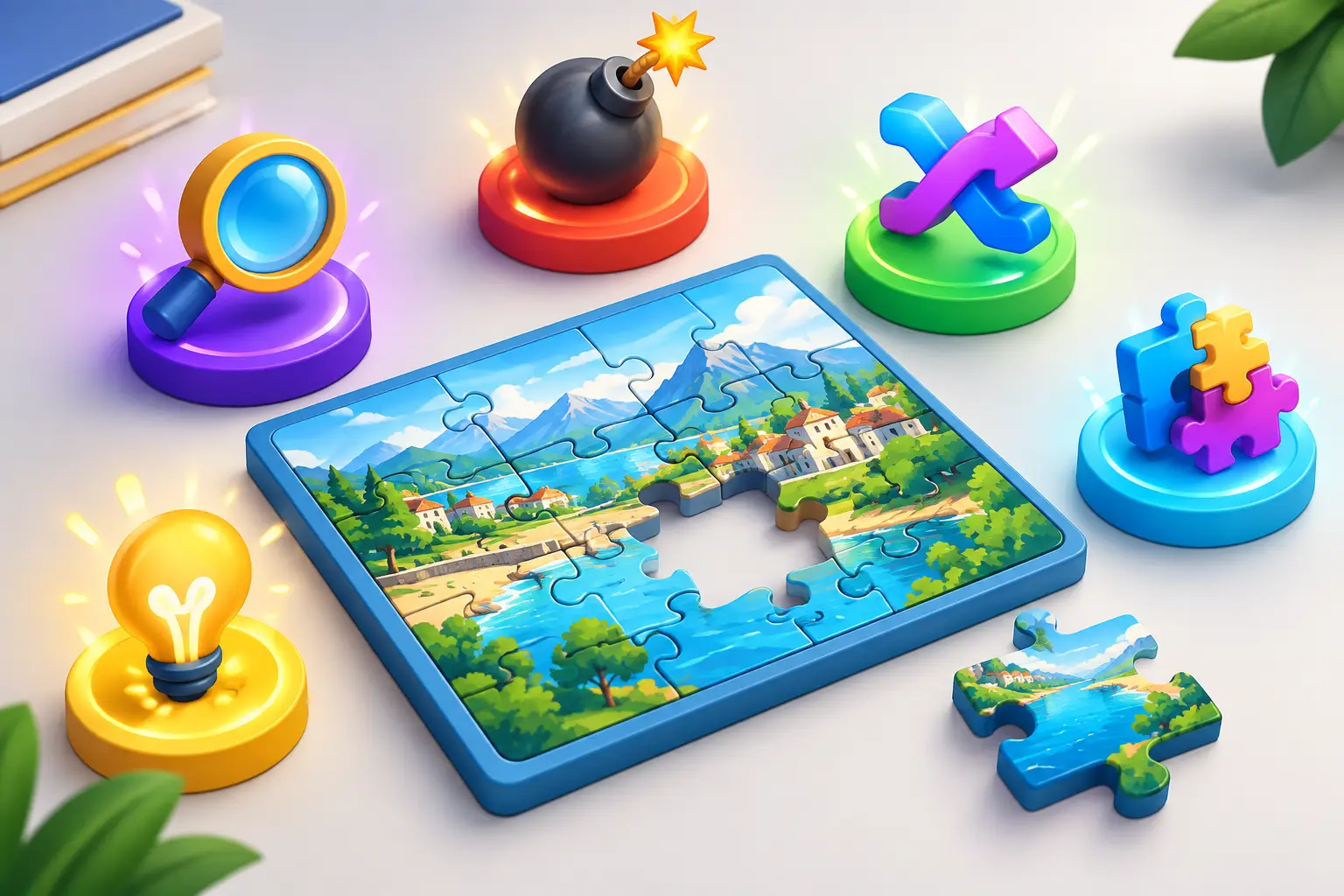
A tough board can change the mood of a five-minute break. One turn you are lining up an easy match beside a flowerbed, and the next you are one tile away from clearing the last obstacle. This puzzle booster review looks at the tools that make those moments feel satisfying rather than frustrating: what each type of booster is good for, when it is worth using one, and when your next swap is probably all you need.
Boosters are at their best when they support a smart plan, not when they replace one. In a well-designed match-3 game, the board should still reward observation: spotting a cascade, opening up a crowded corner, or saving a special piece until it can reach several goals at once. A booster adds a little flexibility to that puzzle. It gives you a way to protect a promising run, clear a stubborn final space, or start a level with a useful advantage when you would rather keep your evening moving.
Puzzle Booster Review: What Makes a Booster Feel Fair?
The most useful boosters do one clear job. You should be able to look at a board, recognize the obstacle slowing you down, and choose a tool with confidence. A targeted hammer-style booster, for example, is valuable because it removes one piece exactly where you need it. A board-clearing blast has a different purpose: it creates room when the level has become cluttered and your best matches are blocked.
That clarity matters more than spectacle. A dramatic animation is fun once, but the real pleasure comes from seeing why the booster worked. You remove one stubborn crate, a path opens, a special match drops into place, and the board begins to breathe again. The result feels earned because you made the call at the right moment.
A fair booster system also respects the difference between a challenging level and an unlucky opening board. Some stages ask for patience and a few attempts before their pattern becomes clear. Others can turn on a single difficult tile near the edge. Having a small collection of tools means you can decide whether the puzzle is worth another try as-is or whether one well-placed assist will make the session more enjoyable.
At Garden Match Puzzles, that choice stays with the player. You can always play, while boosters and optional purchases are there to enhance progress rather than stand between you and the next level. That is especially welcome for players who enjoy a calming nightly routine and want a full game session, not a negotiation with a timer.
The Boosters Worth Saving for the Right Board
Not every booster deserves the same level of caution. The best approach is to think about the board state, not simply how close you are to winning. If a level has several turns left and a wide-open play area, hold onto your tools. If you have one move left, the final objective is isolated, and a precise booster can finish the job, that is a strong use.
Targeted removers solve specific problems
A single-tile remover is usually the quiet hero of a booster collection. Save it for the piece that has resisted every ordinary match: an obstacle tucked into a corner, a final patch of grass beneath an awkward tile, or the one item keeping a collection goal incomplete.
The common mistake is using it early because a tile looks inconvenient. Before you do, check whether a match nearby could shift the board and solve the problem for free. Targeted tools become much more valuable once the board has settled and you know that the tile truly is isolated.
Area clears create breathing room
A larger blast is most helpful when a level feels compressed. Maybe several blockers are grouped around the center, or the board has split into small sections with too few match options. Clearing an area can reconnect those sections and create the space needed for special pieces to form.
Use these boosters with a destination in mind. Do not simply clear the busiest area because it looks messy. Pick the location that opens a route toward your goal, such as the section holding most of the remaining obstacles or the column that lets pieces fall into an empty lower corner.
Pre-level boosters improve the opening
Starting boosters can be excellent on levels where the first few moves set the tone. An early special piece may clear the center before blockers spread across the board, while an opening advantage can help you reach a hard-to-access area before it gets crowded.
Still, pre-level boosters involve a trade-off. Once they are activated, you have committed before seeing exactly how the board will develop. They are best for a level you already understand after a previous attempt. If you are entering a fresh stage, playing the opening normally often teaches you more about its layout.
Extra moves protect a nearly finished plan
Extra moves feel especially good when you have done the hard part already. The board is open, the goals are in reach, and you can see two or three useful matches waiting. In that situation, a few additional turns do not just extend the level. They let a good strategy reach its natural finish.
They are less useful when the board remains tangled and there is no obvious path forward. More turns cannot always fix a board with no room to work. A targeted or area-clearing tool may create a better next move first.
A Simple Way to Decide Before You Tap
When a level gets close, pause for a few seconds before using anything. Ask three questions: What is the one objective preventing the win? Can an ordinary match reach it? Will this booster create a clear follow-up move?
That final question is the one many players skip. A booster that clears one obstacle is helpful. A booster that clears an obstacle, causes a cascade, and drops two special pieces together is far more useful. Look for places where the board is already ready to react.
It also helps to count the remaining goals rather than judge the board by how busy it looks. Five scattered tiles may be easier to clear than two protected ones. If the remaining task is manageable with a couple of sensible matches, save your booster for a later board with a narrower solution.
This pause keeps boosters from becoming an automatic response to a near miss. A near miss can be useful information. You may have learned that the lower-left corner needs attention first, that a certain blocker must be opened early, or that a special-piece combination is more effective than clearing individual tiles. The next attempt may bloom quickly without any extra help.
How to Build a Booster Habit That Stays Relaxed
Daily rewards, event milestones, and level progress can gradually fill your collection, so there is no need to treat every booster like a museum piece. The point is to use them where they genuinely improve your experience. If a tool turns a stalled level into a satisfying finish, that is a good use.
At the same time, keeping a small reserve gives you freedom during longer stretches of play. You might choose a few dependable tools for difficult late-world boards and use the rest more casually when you are exploring a seasonal event or working toward a new garden detail. A bench, a bloom-filled path, or a freshly decorated corner feels better when the progress came from a session you enjoyed.
Players who prefer a more strategic rhythm can set a gentle personal rule: try a new level once without help, then decide whether a booster would address a specific obstacle on the next attempt. Players who want a softer wind-down can make the opposite choice and use a favorite tool whenever it keeps the game pleasant. Both approaches are valid because the goal is not perfect efficiency. It is a rewarding puzzle break that fits your day.
The Verdict: Use Tools to Keep the Good Part Going
The strongest boosters are not the loudest ones. They are the ones that make a difficult board readable again, give a smart plan one more chance, and leave you feeling like your decision mattered. Targeted removers are ideal for isolated goals, area clears are excellent for crowded layouts, pre-level tools shine on familiar boards, and extra moves work best when victory is already taking shape.
Keep an eye on the board, save your most precise tools for precise problems, and let yourself use a booster when it preserves the pleasure of the puzzle. A garden grows one thoughtful choice at a time, and so does a satisfying match-3 session.